What is Sales Forecast?
A sales forecast is a prediction of future sales revenue over a specific time period, typically based on pipeline analysis, historical data, and rep input. It answers the critical business question: how much revenue will we generate? Accurate forecasting enables resource planning, cash flow management, and investor confidence. Poor forecasting leads to missed targets, surprise shortfalls, and loss of credibility.
Why Sales Forecast Matters
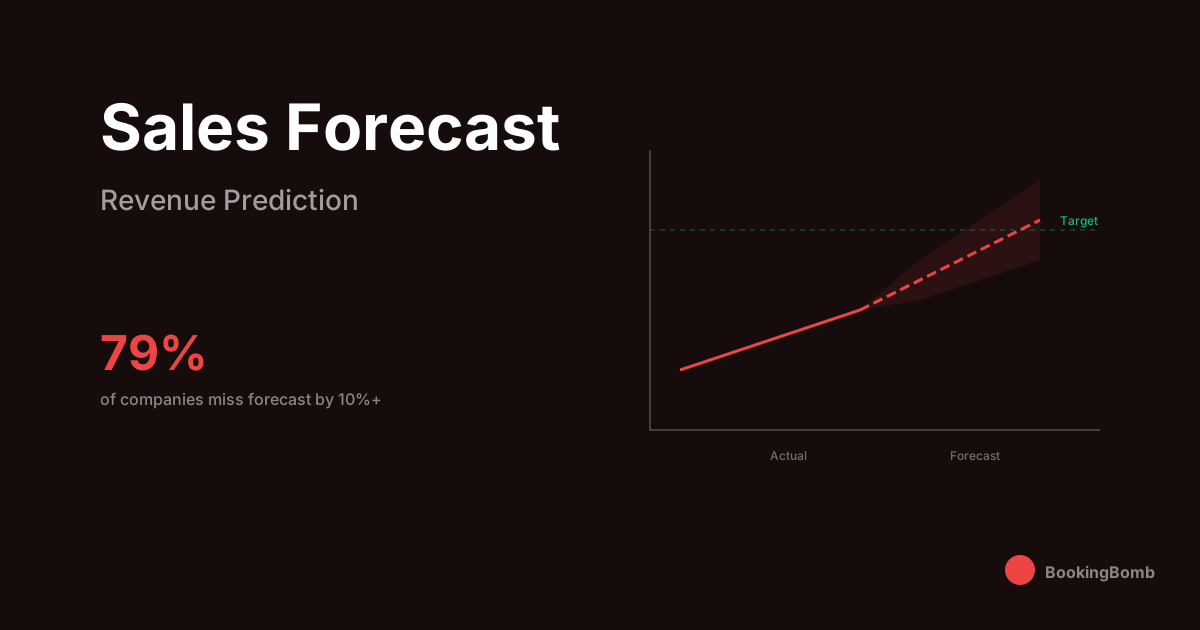
Forecasting isn't just a sales exercise—it drives entire company decisions. Hiring plans, marketing budgets, inventory levels, and investor communications all depend on revenue predictions. When forecasts miss, everything built on those predictions fails. Most sales organizations struggle with forecast accuracy. Studies show 79% of companies miss their forecast by more than 10%. This isn't just an inconvenience—it erodes trust between sales and executive leadership, leads to panic decisions, and can tank stock prices for public companies. Accurate forecasting requires discipline throughout the sales process. Pipelines must be clean, stage definitions must be consistent, and reps must be honest about deal health. The forecast itself is just math—the hard part is the data quality and human judgment beneath it.
79%
of companies miss forecast by 10%+
45%
of deals forecasted to close don't
3-6
months typical B2B forecast horizon
How Sales Forecast Works
Define forecast categories
Create clear categories—committed, best case, pipeline. Each should have specific criteria so reps categorize consistently.
Gather deal-level inputs
Reps assess each opportunity: stage, expected value, close date, and confidence level. This bottoms-up input is foundational.
Apply historical conversion rates
Use past performance to adjust rep optimism. If Stage 3 deals historically close 40% of the time, weight them accordingly.
Layer in judgment
Sales leadership reviews the numbers, considering factors models miss—rep track record, deal-specific risks, market conditions.
Roll up to forecast
Combine deal-level forecasts into team, regional, and company forecasts. Compare to quota and plan.
Track and iterate
Compare forecasts to actuals to identify systematic biases. Are you always optimistic? Certain reps consistently off? Adjust methodology based on learnings.
Best Practices
Use multiple forecast methods and triangulate—bottoms-up, historical, and statistical
Create clear category definitions and enforce them—'commit' should mean commit
Review forecasts weekly and require deal-specific justification for changes
Track forecast accuracy by rep to identify who needs coaching
Apply aging factors—deals stuck too long are less likely to close
Separate forecast from motivation—sandbaggers and happy ears both hurt accuracy
Use forward-looking indicators, not just current pipeline—new pipeline creation matters too
Build forecast accuracy into sales compensation and promotion criteria
Common Mistakes
- • Treating the forecast as a goal instead of a prediction—wishing doesn't make it real
- • Not penalizing or coaching bad forecasters—accuracy must have consequences
- • Using vague category definitions that let reps interpret differently
- • Only forecasting current quarter—visibility into future quarters catches problems early
- • Not adjusting for known biases—if you always miss by 15%, factor that in
- • Changing forecasts too frequently—stability builds credibility
- • Conflating forecast with pipeline—they measure different things
Related Terms
Stop Studying. Start Closing.
Now you know what Sales Forecast means. Let us put it to work for you.
Book Your Strategy Call