What is Pipeline Coverage?
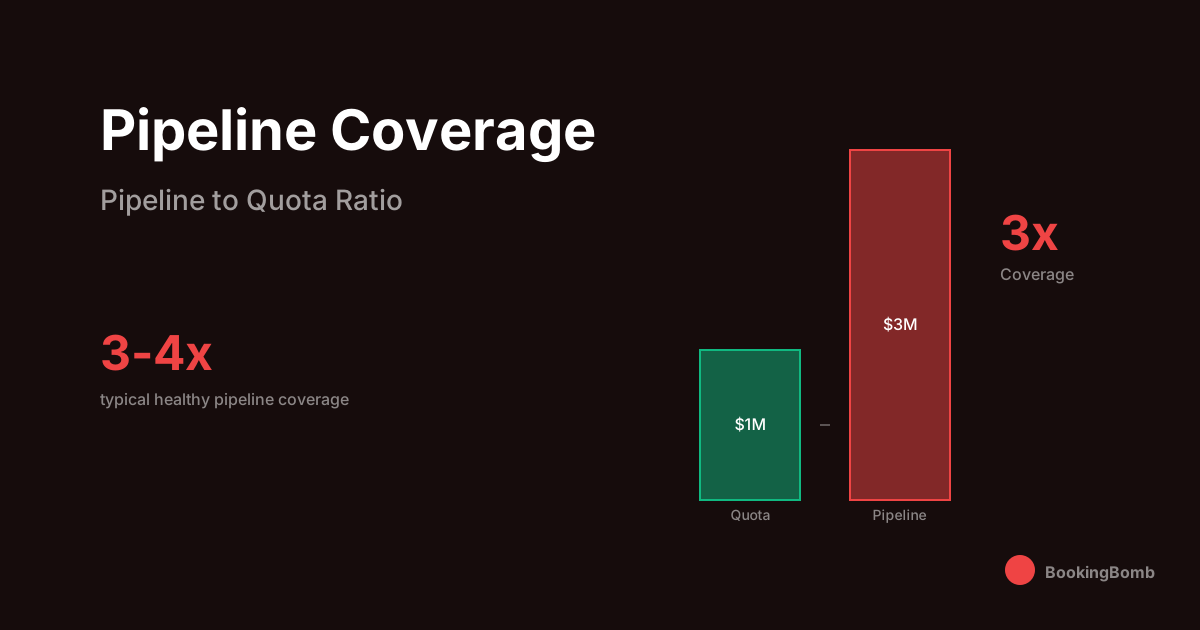
Pipeline coverage is the ratio of pipeline value to quota or revenue target, typically expressed as a multiple (e.g., 3x coverage means pipeline is three times the target). It measures whether you have enough potential deals to hit your goals, accounting for the fact that not all pipeline will close. Pipeline coverage is the leading indicator that predicts whether you'll make your number.
Why Pipeline Coverage Matters
Pipeline coverage tells you if you're on track before it's too late. If your win rate is 25% and you need $1M in revenue, you need $4M in pipeline. With only $2M, you're mathematically going to miss—and you know it weeks or months in advance, while there's still time to act. Coverage creates accountability at every level. Reps track personal coverage, managers track team coverage, and executives track company coverage. When coverage drops below target, it triggers pipeline generation activities before quota is at risk. Most importantly, coverage connects activity to outcomes. If reps are busy but coverage is low, activities aren't generating enough qualified pipeline. If coverage is high but deals aren't closing, qualification or sales execution needs work. Coverage is the diagnostic that links inputs to outputs.
3-4x
typical healthy pipeline coverage
89%
of high performers track coverage
2x
minimum coverage for forecast confidence
How Pipeline Coverage Works
Calculate current pipeline value
Sum the value of all active opportunities expected to close within the measurement period. Use consistent stage criteria.
Determine your target
Identify the quota or revenue target for the same period. This is your denominator.
Calculate the ratio
Divide pipeline by target. $3M pipeline / $1M quota = 3x coverage.
Adjust for stage and probability
Consider weighted coverage that factors in stage probabilities. Early-stage deals should count less than late-stage.
Compare to historical needs
Based on your win rate, determine how much coverage you actually need. 20% win rate requires 5x; 33% requires 3x.
Track trend over time
Monitor coverage weekly. Declining coverage signals future problems; increasing coverage suggests improving pipeline health.
Best Practices
Calculate coverage by period—this quarter's coverage is different from next quarter's
Use weighted coverage for more accurate predictions—weight by stage probability
Set minimum coverage thresholds and alert when falling below
Segment coverage by rep, segment, and deal type for visibility into gaps
Connect coverage to pipeline generation activities—low coverage should trigger action
Account for pipeline aging—stale deals shouldn't count the same as fresh ones
Review coverage in weekly pipeline reviews—it's a core health metric
Use coverage to set activity targets—work backward from coverage needs
Common Mistakes
- • Counting pipeline without probability weighting—early and late stage aren't equal
- • Not accounting for your actual win rate—needed coverage varies by close rate
- • Including stale or zombie deals in coverage calculations—this inflates false confidence
- • Only tracking at the company level—rep and segment coverage reveals gaps
- • Not acting on low coverage until it's too late—coverage is a leading indicator
- • Using arbitrary coverage targets without data—your win rate should drive the target
- • Treating all pipeline equally regardless of quality or deal size
Related Terms
Stop Studying. Start Closing.
Now you know what Pipeline Coverage means. Let us put it to work for you.
Book Your Strategy Call