What is Lead Scoring?
Lead scoring is a methodology for ranking prospects against a scale that represents their perceived value to the organization. Points are assigned based on demographic fit (who they are) and behavioral signals (what they do), creating a numerical score that helps sales and marketing prioritize which leads to pursue first. High scores mean high priority; low scores mean nurture or disqualify.
Why Lead Scoring Matters
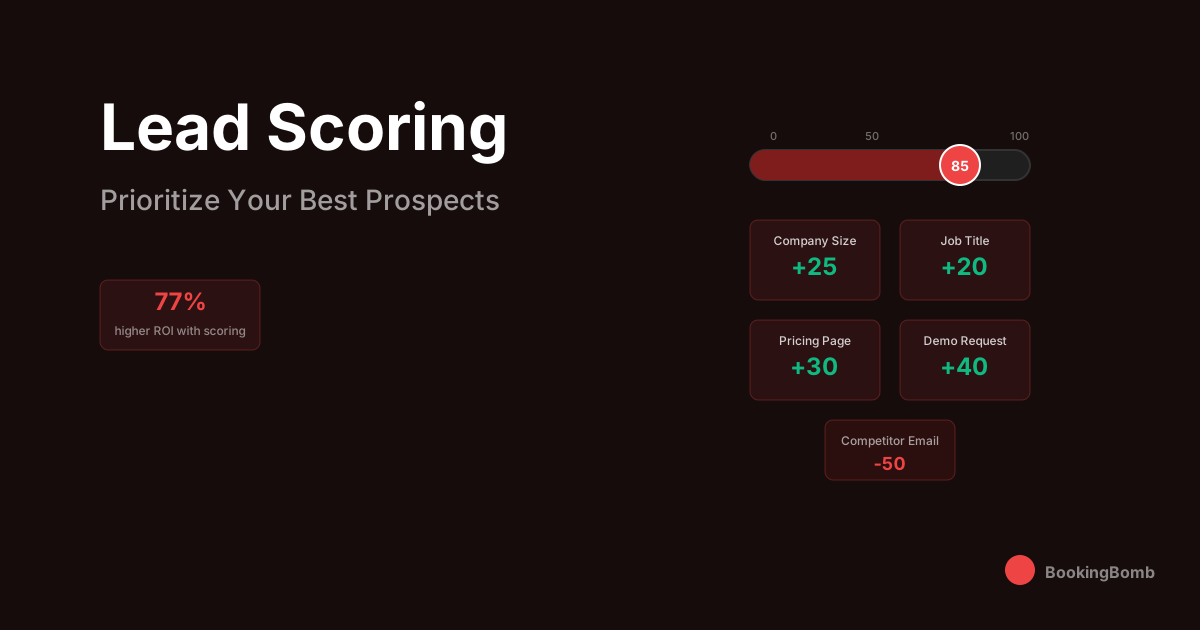
Not all leads are created equal, and treating them equally is expensive. Lead scoring solves the fundamental problem of resource allocation in sales—with limited time and reps, who should you call first? Without scoring, sales teams either cherry-pick based on gut feel (inconsistent) or work leads first-in-first-out (inefficient). Neither approach maximizes revenue. Companies using lead scoring see 77% higher lead generation ROI because they focus energy where it matters. Lead scoring also bridges the eternal sales-marketing divide. Instead of arguing about lead quality, both teams align on objective criteria. When marketing passes a lead scored 85+, sales knows exactly what that means. Lead scoring becomes even more powerful with automation. High-scoring leads can be instantly routed to top reps, trigger urgent alerts, or skip nurture sequences entirely. This speed matters—responding to leads within 5 minutes makes you 21x more likely to qualify them.
77%
higher lead gen ROI with scoring
68%
of marketers use lead scoring
21x
more likely to qualify with fast response
How Lead Scoring Works
Define ideal customer profile
Start by documenting what makes a great customer—company size, industry, role, technology stack, etc. This becomes your demographic scoring rubric.
Map behavioral signals
Identify actions that indicate buying intent—pricing page visits, demo requests, multiple content downloads, email engagement. Assign point values based on signal strength.
Assign positive and negative scores
Add points for fit and engagement, subtract points for poor fit (wrong industry, competitor email domains, student email addresses).
Set thresholds for action
Define what scores trigger what actions—under 30 goes to nurture, 30-60 gets SDR outreach, over 60 goes directly to AE, over 80 triggers urgent alert.
Integrate with your tech stack
Connect scoring to your CRM, marketing automation, and routing tools. Scores should update in real-time and trigger automated workflows.
Continuously calibrate
Review which scores actually convert. If 50-point leads close as often as 80-point leads, your model is broken. Adjust weights based on real conversion data.
Best Practices
Use both explicit (fit) and implicit (behavior) scoring—neither alone tells the full story
Weight recent activity more heavily—a page view yesterday beats a webinar from 6 months ago
Include negative scoring for disqualifying signals—competitors, students, unsubscribes
Start simple and iterate—a basic model you use beats a complex model gathering dust
Review closed-won and closed-lost deals to validate and refine your model
Score accounts in addition to contacts for ABM strategies
Decay scores over time—engagement intent fades if not acted upon
Get sales input on scoring criteria—they know what actually converts
Common Mistakes
- • Making the model too complex—dozens of criteria create a black box nobody trusts
- • Not including negative scores—bad-fit leads can rack up points from curiosity browsing
- • Setting thresholds arbitrarily instead of based on conversion data
- • Scoring only marketing touches while ignoring sales engagement signals
- • Failing to decay scores—last year's webinar attendee isn't the same lead today
- • Not re-calibrating after product or market changes
- • Letting scores override obvious signals—a demo request beats any point total
- • Using lead scoring without proper data hygiene—garbage in, garbage out
Related Terms
Stop Studying. Start Closing.
Now you know what Lead Scoring means. Let us put it to work for you.
Book Your Strategy Call