What is ICP?
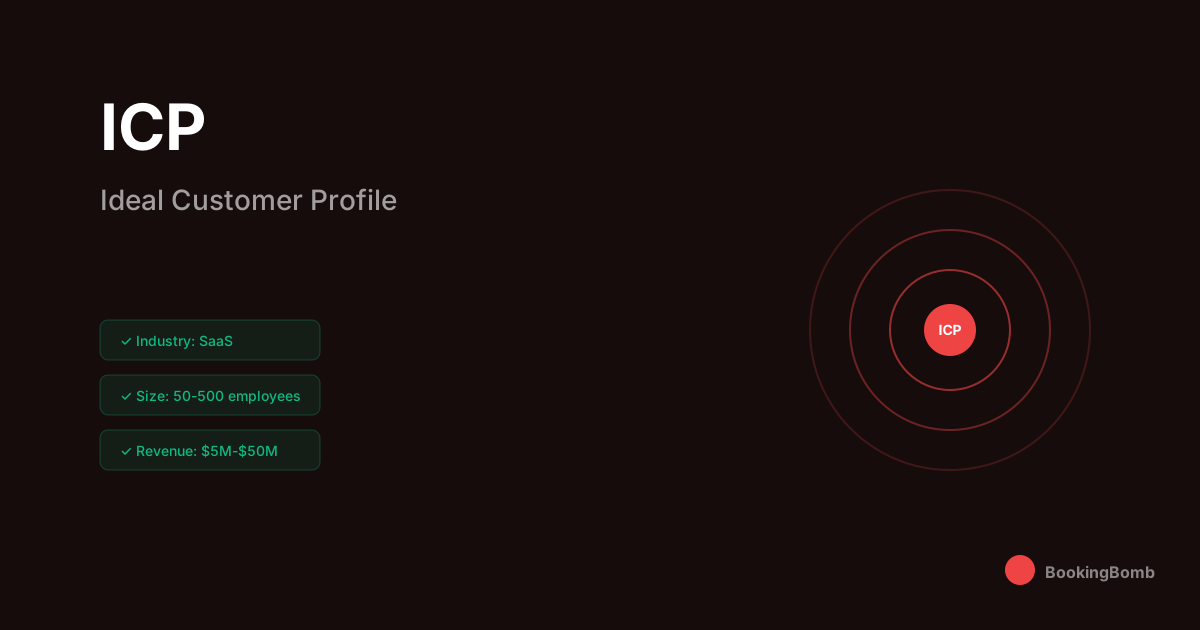
An Ideal Customer Profile (ICP) is a detailed description of the type of company that would benefit most from your product or service and provide the most value back to your business. Unlike buyer personas (which describe individuals), ICPs define company-level characteristics like industry, size, technology stack, and business model. Your ICP is the blueprint for who you should be selling to.
Why ICP Matters
Trying to sell to everyone means selling effectively to no one. Your ICP focuses your entire go-to-market engine—marketing creates content for ICP companies, SDRs prospect ICP accounts, and sales prioritizes ICP deals. Without an ICP, you waste resources chasing poor-fit prospects who churn quickly or never close. Companies with well-defined ICPs see 68% higher win rates because they're fishing in the right pond. Your ICP should be based on data, not assumptions. Analyze your best customers—the ones who close fastest, pay the most, renew consistently, and expand over time. What do they have in common? Those patterns become your ICP criteria. The tighter your ICP definition, the more efficient your growth. It's counterintuitive, but narrowing your target actually accelerates growth by concentrating resources where they work best.
68%
higher win rates with defined ICP
50%
shorter sales cycles when targeting ICP
3x
higher LTV from ICP-fit customers
How ICP Works
Analyze best customers
Pull data on your top performers—highest LTV, fastest closes, best retention, most expansion. Look for patterns in company characteristics.
Identify firmographic criteria
Define industry verticals, company size (employees and revenue), geography, and business model characteristics that correlate with success.
Map technographic signals
Identify technology stack patterns—what tools do best customers use? This reveals sophistication level and integration opportunities.
Document negative criteria
Equally important: who is NOT your ICP? Define disqualifying characteristics to prevent wasted effort on poor fits.
Validate with sales and CS
Get input from teams who interact with customers daily. They know which deals close smoothly and which become nightmares.
Operationalize across teams
Build ICP criteria into lead scoring, territory planning, prospecting lists, and qualification frameworks. Make ICP fit visible everywhere.
Best Practices
Base ICP on data from your best customers, not aspirational targets
Include both positive criteria (what to target) and negative criteria (what to avoid)
Review and refine ICP quarterly as you learn more about what works
Tier your ICP—Tier 1 gets the most resources, Tier 2 gets standard coverage
Align ICP across marketing, sales, and customer success for consistent targeting
Use ICP fit as a primary factor in lead scoring and deal prioritization
Don't make ICP too narrow initially—you need enough market to hit targets
Document ICP formally and make it accessible to everyone in go-to-market
Common Mistakes
- • Defining ICP based on who you want to sell to instead of who actually buys
- • Making ICP too broad—'any company with 50+ employees' isn't an ICP
- • Not including negative criteria—knowing who to avoid is equally valuable
- • Confusing ICP (company profile) with buyer persona (individual profile)
- • Setting ICP once and never revisiting as market and product evolve
- • Not operationalizing ICP—a document nobody uses provides no value
- • Ignoring customer success input—they know which customers actually succeed
Related Terms
Stop Studying. Start Closing.
Now you know what ICP means. Let us put it to work for you.
Book Your Strategy Call