What is ABM?
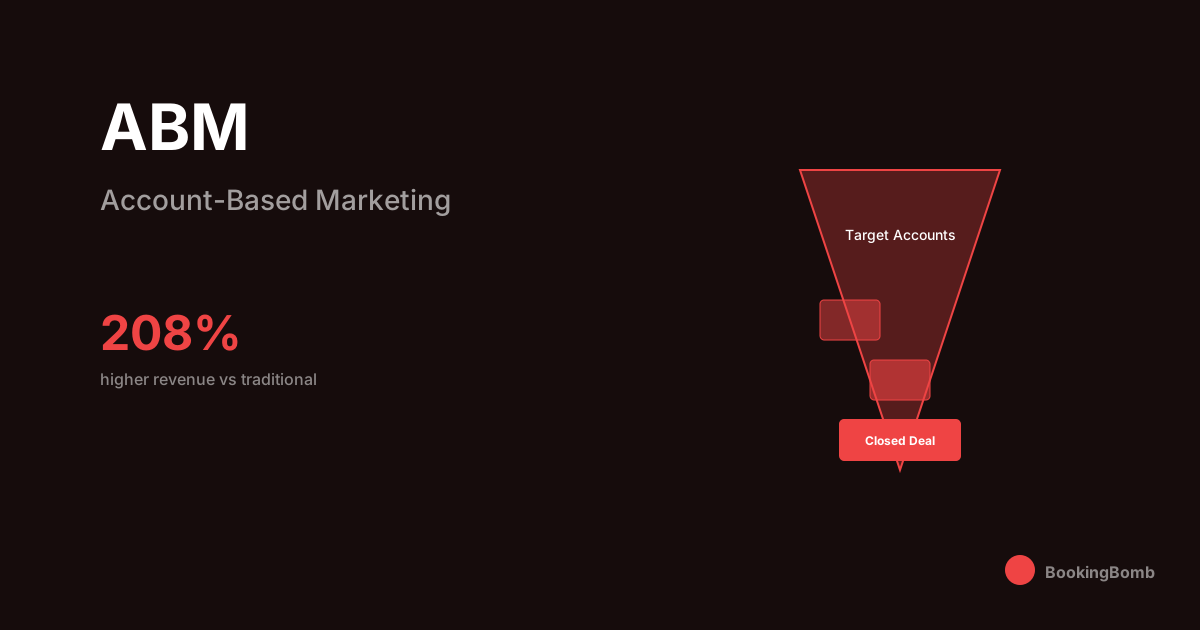
Account-Based Marketing (ABM) is a strategic approach that concentrates sales and marketing resources on a defined set of target accounts, treating each account as a market of one. Instead of casting a wide net and hoping to catch fish, ABM identifies the specific fish you want and customizes every interaction to land them. It flips the traditional funnel—starting with accounts and working toward engagement rather than generating leads and hoping some fit.
Why ABM Matters
In B2B, not all accounts are created equal. A handful of large enterprise deals can generate more revenue than hundreds of SMB customers. ABM focuses resources where they'll have the biggest impact—on the accounts that can actually move the needle. The ROI math is compelling: ABM programs deliver 208% higher revenue than traditional marketing approaches. Companies using ABM also report 84% improvement in reputation and 74% improvement in customer relationships because they're engaging accounts with relevance instead of generic spam. ABM also solves the sales-marketing alignment problem. When both teams agree on target accounts and coordinate their efforts, finger-pointing disappears. Marketing knows exactly who to reach, and sales gets accounts that are already engaged and educated. It's the ultimate team sport.
208%
higher revenue from ABM vs traditional marketing
84%
of companies say ABM improves reputation
91%
of ABM users report larger deal sizes
How ABM Works
Identify target accounts
Use ICP criteria, intent data, and sales input to build a target account list. Start with 50-100 accounts for pilot programs.
Research and map accounts
Deep-dive into each account—understand their business, challenges, key stakeholders, and current solutions. Build account plans.
Create personalized content
Develop content and messaging tailored to each account's specific situation—industry, challenges, stakeholders. One-size-fits-all doesn't work in ABM.
Execute multi-channel campaigns
Reach target accounts through display ads, LinkedIn, email, direct mail, events, and personalized outreach. Surround accounts with relevant touchpoints.
Coordinate with sales
Sales and marketing work the same accounts simultaneously. Marketing warms accounts while sales pursues direct outreach. Share intelligence constantly.
Measure account engagement
Track engagement at the account level, not just lead level. Are target accounts visiting your site? Opening emails? Engaging with content?
Best Practices
Start with a pilot on your top 50 accounts before scaling to hundreds
Get sales buy-in on the target account list—they need to own it too
Invest in personalization—generic ABM is just expensive traditional marketing
Use intent data to identify accounts actively researching your category
Measure account engagement and progression, not just lead volume
Tier your accounts—top tier gets 1:1 personalization, lower tiers get 1:few
Align incentives—both sales and marketing should be measured on account outcomes
Be patient—ABM is a long game; enterprise deals take time
Common Mistakes
- • Selecting too many accounts—ABM requires focus; 1,000 accounts isn't ABM
- • Not personalizing enough—sending the same email to all accounts defeats the purpose
- • Running ABM without sales alignment—uncoordinated efforts confuse accounts
- • Expecting instant results—ABM builds relationships over quarters, not weeks
- • Only using digital channels—enterprise ABM often requires offline touchpoints
- • Not tracking account-level metrics—lead-level measurement misses the point
- • Choosing accounts based on wishful thinking instead of fit and intent signals
Related Terms
Stop Studying. Start Closing.
Now you know what ABM means. Let us put it to work for you.
Book Your Strategy Call