What is SQL?
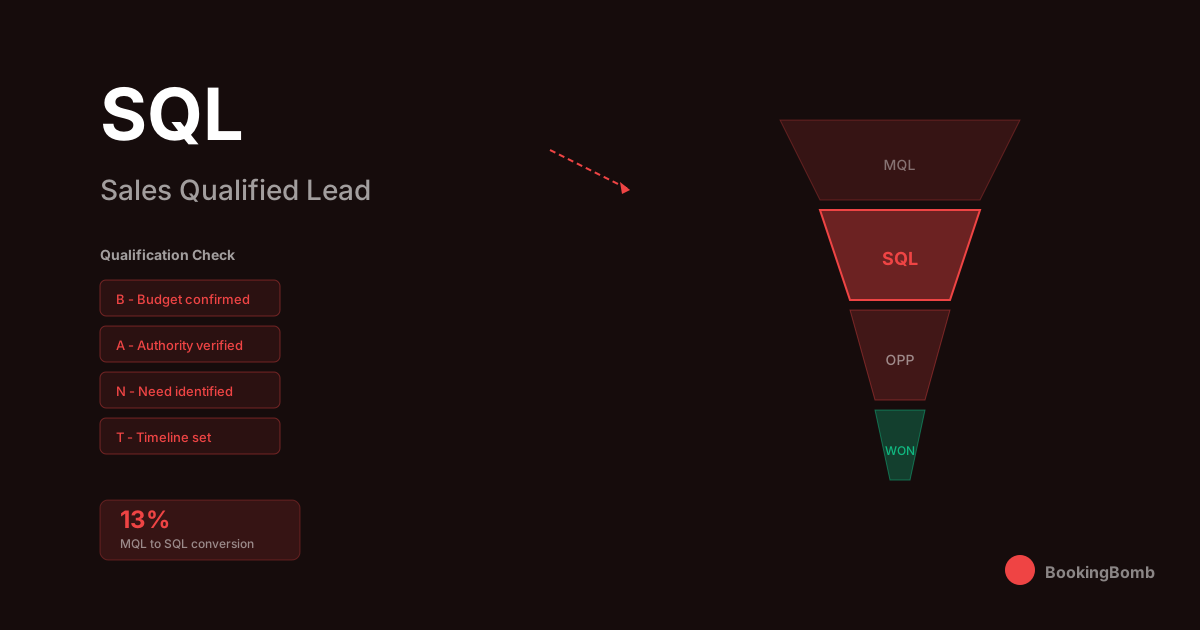
A Sales Qualified Lead (SQL) is a prospective customer who has been researched and vetted by both marketing and sales teams and is deemed ready for direct sales engagement. Unlike MQLs who merely showed interest, SQLs have demonstrated genuine buying intent and fit your ideal customer profile—they're the leads your sales team should actually be spending time on.
Why SQL Matters
SQLs are the lifeblood of your revenue engine. While MQLs are important for building pipeline, SQLs are where deals actually happen. The distinction matters because sales time is expensive—a typical B2B sales rep costs $100,000+ annually in fully loaded costs. Every minute they spend on unqualified leads is money down the drain. Companies with strong SQL definitions see 38% higher win rates and 28% shorter sales cycles because reps focus on opportunities that can actually close. Without clear SQL criteria, you're essentially asking your highest-paid employees to play detective instead of doing what they're paid to do: sell. The MQL-to-SQL handoff is where most B2B companies leak revenue. Get it wrong, and you're either overwhelming sales with garbage leads (killing morale and conversion rates) or starving them of pipeline (killing quota attainment). Get it right, and you've built a predictable revenue machine.
13%
average MQL to SQL conversion rate
38%
higher win rates with defined SQL criteria
6x
more likely to close than cold outreach
How SQL Works
MQL passes initial qualification
A lead first becomes an MQL by engaging with marketing content and matching demographic criteria. This filters out the completely unqualified prospects.
Sales Development Rep (SDR) outreach
An SDR contacts the MQL to verify interest, understand their situation, and determine if there's a real opportunity. This typically happens via phone, email, or LinkedIn.
BANT or similar qualification
The SDR qualifies the lead using a framework like BANT (Budget, Authority, Need, Timeline) or MEDDIC. The goal is to confirm the prospect has a real problem, can make decisions, and has resources to buy.
SQL handoff to Account Executive
Once qualified, the lead becomes an SQL and is handed to an Account Executive (AE) for deeper discovery and deal progression. The AE receives all qualification notes and context.
Opportunity creation in CRM
The SQL is converted to an opportunity with an estimated deal value and close date. Now it's part of your formal pipeline and revenue forecast.
Best Practices
Define SQL criteria jointly between sales and marketing—this prevents finger-pointing and ensures both teams have skin in the game
Use a consistent qualification framework (BANT, MEDDIC, GPCTBA/C&I) so every rep qualifies the same way
Set SLA response times—SQLs should be contacted within 5 minutes for highest conversion rates
Track SQL acceptance rate—if sales is rejecting more than 20% of SQLs, your criteria needs tightening
Document disqualification reasons to improve MQL scoring upstream
Implement lead recycling—rejected SQLs shouldn't disappear; they go back to nurture
Score engagement recency—recent activity trumps historical engagement every time
Require discovery calls before SQL status—a form fill alone shouldn't make someone sales-ready
Common Mistakes
- • Letting marketing define SQL criteria without sales input—this guarantees misalignment
- • Using demo requests as the only SQL trigger—many high-intent buyers research differently
- • Not having a formal handoff process—leads fall through cracks and blame games ensue
- • Counting SQLs without tracking SQL-to-opportunity conversion—vanity metrics help no one
- • Setting SQL bars too high in pursuit of quality—you'll starve your pipeline
- • Setting SQL bars too low to hit lead goals—you'll burn out your sales team
- • Not re-qualifying stale SQLs—buying intent decays quickly; a 90-day-old SQL isn't the same lead
- • Treating all SQLs equally regardless of deal size potential—prioritization matters
Related Terms
Stop Studying. Start Closing.
Now you know what SQL means. Let us put it to work for you.
Book Your Strategy Call