What is Conversion Rate?
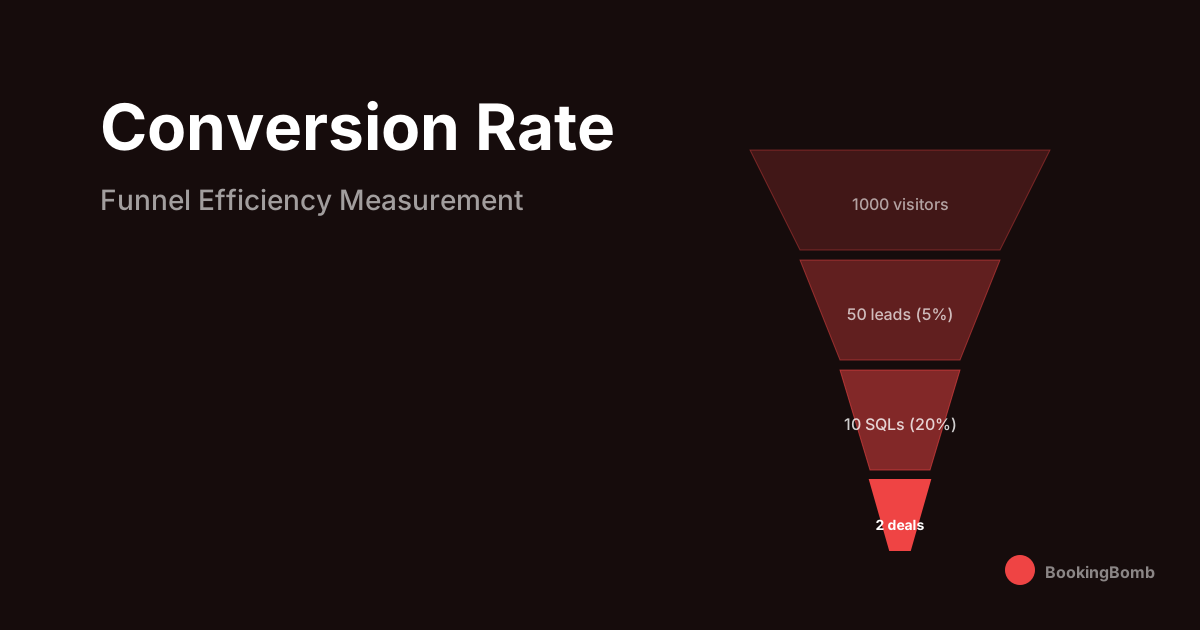
Conversion rate is the percentage of prospects who complete a desired action out of the total who had the opportunity to do so. In B2B sales and marketing, conversion rates measure efficiency at every stage—from website visitor to lead, lead to MQL, MQL to SQL, SQL to opportunity, and opportunity to closed deal. It's the fundamental metric for understanding and optimizing your funnel.
Why Conversion Rate Matters
Conversion rates reveal where your funnel leaks. A 2% website-to-lead rate and 50% SQL-to-opportunity rate tell you exactly where to focus improvement efforts. Small conversion improvements compound dramatically—increasing each stage by just 10% can double your output without increasing top-of-funnel spend. Conversion rates also enable forecasting and planning. If you know your conversion rates, you can work backward from revenue targets to determine exactly how many leads, calls, and meetings you need. Without this math, resource planning is just guessing. The best sales and marketing teams obsess over conversion rates because they're controllable. You can't always generate more leads, but you can always convert existing leads better through better messaging, faster response times, and improved qualification.
2-5%
average B2B website conversion rate
13%
average MQL to SQL conversion
20%
average opportunity to close rate
How Conversion Rate Works
Define conversion events
Identify the key actions that matter at each stage—form fills, meeting bookings, opportunities created, deals closed. Each is a conversion point.
Track numerator and denominator
Conversion = (people who converted) ÷ (people who could have converted). Ensure you're measuring both accurately in your systems.
Segment by relevant dimensions
Calculate conversion rates by source, campaign, rep, segment, and time period. Aggregate rates hide important variation.
Identify bottlenecks
Compare stage conversion rates to benchmarks and internal history. Low-performing stages are optimization opportunities.
Run experiments
Test changes designed to improve conversion—different messaging, faster response times, better qualification criteria.
Monitor for degradation
Conversion rates can drop due to market changes, rep performance issues, or data quality problems. Catch declines early.
Best Practices
Track conversion rates at every meaningful funnel stage, not just leads-to-customers
Segment conversion rates by source—organic, paid, and outbound convert very differently
Set benchmarks and alert thresholds to catch conversion drops quickly
Calculate both point-in-time and cohort conversion rates for different insights
Account for time lag—B2B conversions often take weeks or months to materialize
Use conversion rates in capacity planning—work backward from targets
A/B test systematically to improve conversion, not just implement random changes
Share conversion metrics across teams to create shared accountability
Common Mistakes
- • Only tracking top-of-funnel conversion and ignoring later stages
- • Not segmenting—aggregate conversion rates hide where problems actually are
- • Comparing conversion rates without accounting for lead quality differences
- • Optimizing for conversion rate at the expense of volume—both matter
- • Not accounting for time lag in B2B conversion calculations
- • Changing multiple variables at once, making it impossible to know what worked
- • Celebrating conversion rate improvements that came from cherry-picking easy leads
Related Terms
Stop Studying. Start Closing.
Now you know what Conversion Rate means. Let us put it to work for you.
Book Your Strategy Call