Follow-Up Email Template
Copy. Paste. Customize. Send. Book meetings.
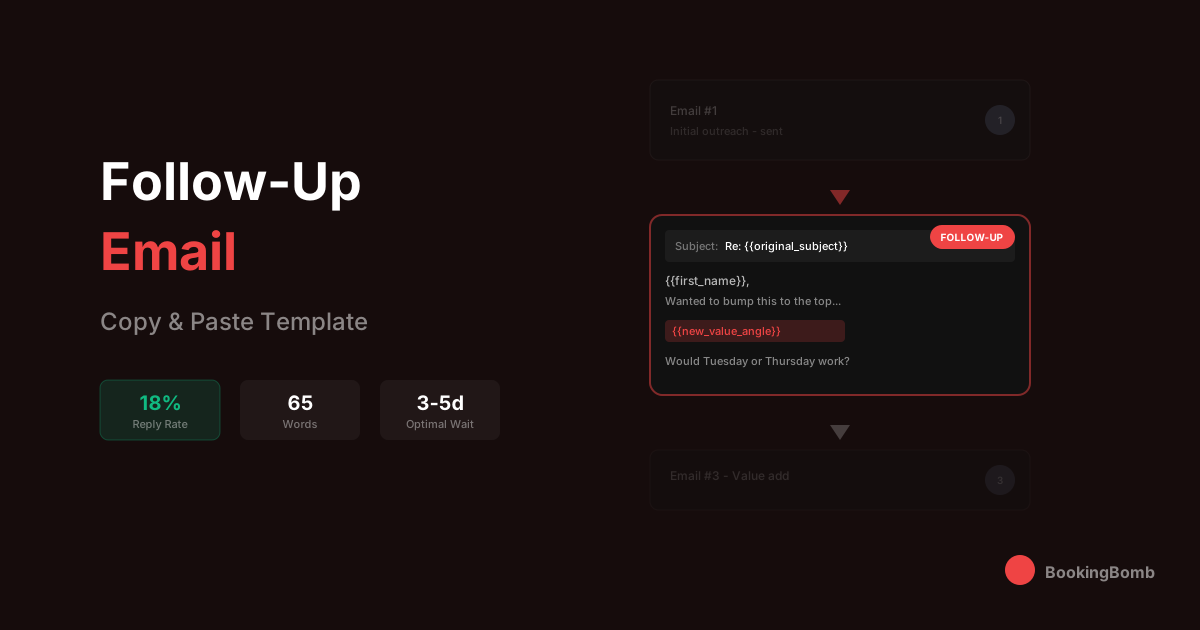
The Template
Subject:
Re: {{original_subject}}
Variables to Customize
{{first_name}}Prospect's first name - keeps it personal and warm
{{company}}Prospect's company name - shows you know who they are
{{original_subject}}The subject line from your first email - threading increases open rates by 40%
{{current_priority}}What they're likely focused on (e.g., 'Q4 planning', 'the product launch', 'scaling the team')
{{new_value_angle}}A fresh benefit or insight not mentioned in email #1 - gives them a reason to reply
{{similar_company}}A reference company in their space - social proof matters
{{timeframe}}Expected results timeline (e.g., '60-90 days', '2 sprints', 'one quarter')
{{day}}Suggested day for call (e.g., 'Tuesday')
{{day_2}}Alternative day for call (e.g., 'Thursday')
{{your_name}}Your first name
When to Use This
Perfect For
- • Second or third touch in a cold email sequence
- • Prospects who opened but didn't reply to your first email
- • Following up 3-5 days after initial outreach
- • Re-engaging prospects after a conference or event
- • Nudging stalled conversations back to life
- • B2B sales cycles where persistence is expected
Not Ideal For
- • Prospects who explicitly asked not to be contacted
- • Following up within 24-48 hours (too aggressive)
- • Leads who have already booked a meeting
- • Mass blast campaigns without segmentation
- • Transactional B2C sales
- • When you have no new value to add
Variations
Variation A: The Value-Add Follow-Up
Variation B: The Casual Bump
Variation C: The Pattern Interrupt
Variation D: The Social Proof Stacker
Variation E: The Question-Based Follow-Up
Variation F: The Short and Sweet
Pro Tips
Tip 1: Thread your follow-ups using 'Re:' in the subject line - it increases open rates by 40% because it looks like an ongoing conversation rather than a new sales pitch
Tip 2: Wait 3-5 business days between follow-ups. Less than 3 days feels aggressive; more than 7 days and they've forgotten you. The sweet spot is 4 days for mid-market, 5-6 for enterprise
Tip 3: Always add NEW value in each follow-up. If you're just saying 'checking in' or 'following up,' you're wasting their time and yours. Share a case study, insight, or resource
Tip 4: Make your CTA stupidly specific. 'Would Tuesday at 2pm or Thursday at 10am work?' converts 2x better than 'Let me know when works for you'
Tip 5: Reference their likely current state. If they opened your first email, they're interested but busy. Acknowledge that reality in your follow-up
Tip 6: Keep it shorter than your first email. Follow-ups should be 50-75 words max. You've already made your pitch - now you're just nudging
A/B Testing Suggestions
Test 'Re:' subject lines vs. fresh subject lines - 'Re:' typically wins for B2B but test for your audience
A/B test follow-up timing: 3 days vs. 5 days vs. 7 days between touches to find your optimal cadence
Compare value-add follow-ups (sharing content/case studies) vs. simple bumps - value-add usually wins but takes more effort
Test asking for a specific meeting time vs. open-ended 'when works for you' - specific times typically convert better
Try question-based opens vs. statement-based opens - questions engage different prospect types
Experiment with email length: ultra-short (30 words) vs. medium (75 words) to see what resonates
Explore More
Sales Articles
Deep-dive guides on follow-up strategies and sequence optimization
Sales Glossary
Key terms like cadence, sequence, and touch points explained
Playbooks
Complete follow-up playbooks for different industries
Benchmarks
Average reply rates and optimal follow-up timing data
Lead Sources
Find prospects worth following up with
Tool Comparisons
Email automation and sequencing tool breakdowns
Related Templates
Templates Are Just the Start
We send thousands of these every week. Let us do the heavy lifting while you close deals.
Book Your Strategy Call