What is Net Revenue Retention?
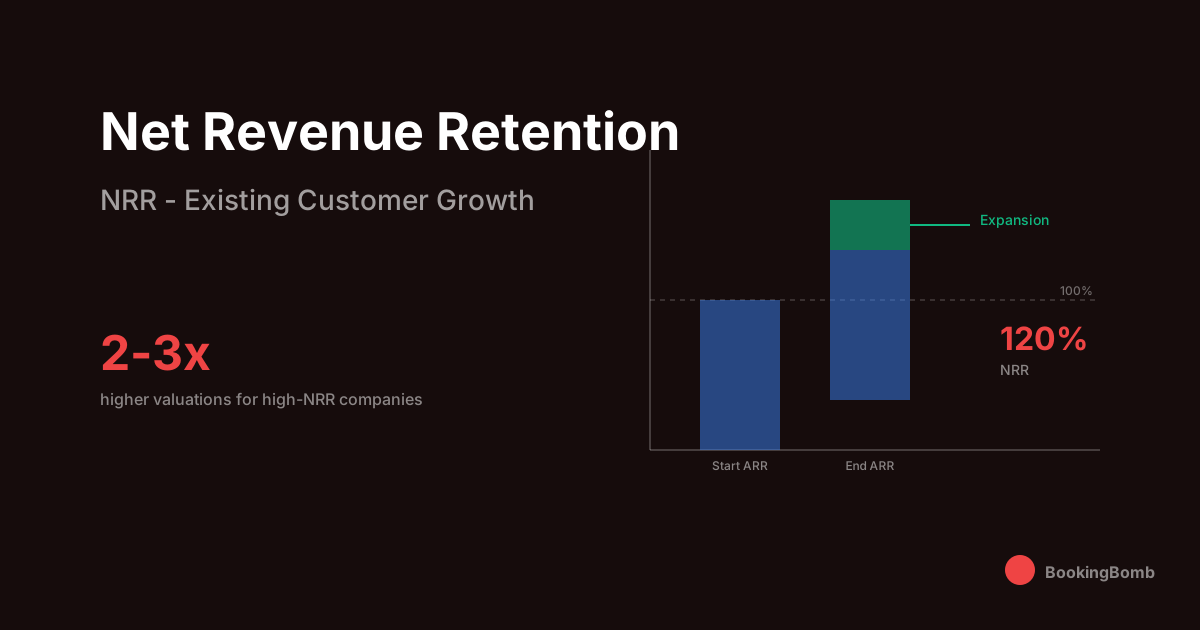
Net Revenue Retention (NRR) measures the percentage of recurring revenue retained from existing customers over a period, including expansion (upsells, cross-sells) and contraction (downgrades, churn). An NRR above 100% means you're growing revenue from your existing customer base even without acquiring new customers. It's the ultimate metric for product-market fit and customer success in subscription businesses.
Why Net Revenue Retention Matters
NRR reveals whether your business can grow sustainably. Companies with NRR above 100% have a built-in growth engine—their existing customers generate more revenue each year even with no new sales. This is the difference between running on a treadmill (needing constant new sales to stay flat) and building compounding growth. High NRR companies are dramatically more valuable. Investors pay 2-3x higher revenue multiples for SaaS companies with NRR above 120% because that revenue is predictable, growing, and doesn't require acquisition spend. NRR is arguably the single most important metric for SaaS company valuation. NRR also indicates product-market fit and customer satisfaction. If customers are expanding, they're getting value. If they're churning, something is wrong. NRR is the financial manifestation of customer success.
100%+
NRR threshold for healthy SaaS
120%+
NRR considered best-in-class
2-3x
higher valuations for high-NRR companies
How Net Revenue Retention Works
Start with beginning ARR
Take the annual recurring revenue from a cohort of customers at the start of the period. This is your denominator.
Add expansion revenue
Include all upsells, cross-sells, and price increases from those customers during the period.
Subtract contraction
Remove revenue lost from downgrades—customers paying less than before.
Subtract churn
Remove revenue from customers who cancelled entirely.
Calculate the ratio
NRR = (Beginning ARR + Expansion - Contraction - Churn) / Beginning ARR × 100. A result above 100% means net growth from existing customers.
Track by cohort and segment
Calculate NRR by customer segment, acquisition cohort, and time period to understand where expansion and churn concentrate.
Best Practices
Track NRR by customer segment—enterprise and SMB often have very different NRR
Analyze components separately—understand what drives expansion and what drives churn
Set NRR targets and make customer success teams accountable
Invest in expansion—upsells often have better economics than new customer acquisition
Use NRR in cohort analysis to identify which customer types retain and expand best
Connect NRR to product usage—high usage typically correlates with expansion
Benchmark against industry peers—NRR standards vary by market and price point
Report NRR to investors and board—it's a key metric they care about
Common Mistakes
- • Only tracking gross retention (which ignores expansion)—NRR tells the full story
- • Not separating NRR by segment—averaging across different customer types is misleading
- • Ignoring contraction—focusing only on churn misses customers who downgrade
- • Not connecting NRR to customer success activities—it's not just a finance metric
- • Treating NRR as a lagging indicator only—use it to identify at-risk accounts early
- • Setting unrealistic NRR targets without investment in customer success
- • Comparing NRR across very different business models without adjustment
Related Terms
Stop Studying. Start Closing.
Now you know what Net Revenue Retention means. Let us put it to work for you.
Book Your Strategy Call