What is CAC?
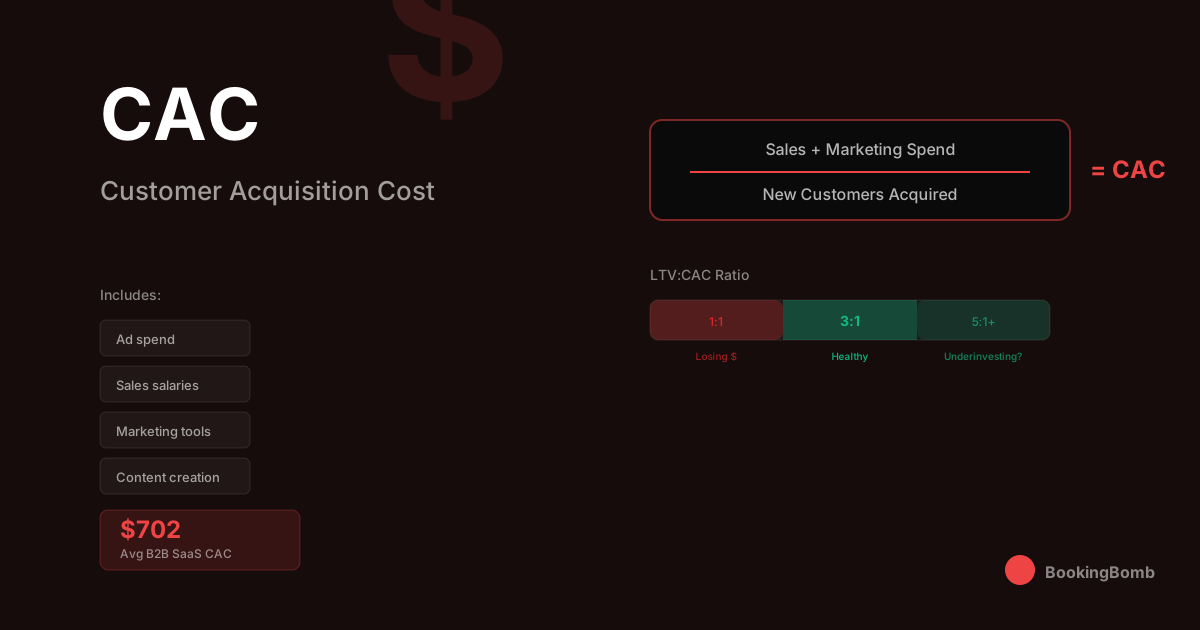
Customer Acquisition Cost (CAC) is the total cost of acquiring a new customer, including all marketing and sales expenses divided by the number of customers acquired in that period. It's the price tag on every new logo you bring in—and arguably the most important metric for understanding whether your growth is sustainable or a path to bankruptcy.
Why CAC Matters
CAC is the reality check every growth-hungry company needs. You can have hockey-stick revenue growth, but if you're spending $500 to acquire customers worth $300, you're just accelerating toward failure. Investors obsess over CAC because it reveals the truth about your business model. A sustainable business has CAC significantly lower than customer lifetime value (LTV)—the gold standard is an LTV:CAC ratio of 3:1 or higher. Below that, and you're either burning cash unsustainably or not investing enough in growth. CAC also exposes the efficiency (or inefficiency) of your go-to-market strategy. If your CAC is climbing while conversion rates stay flat, your market might be saturating. If CAC drops while deal sizes grow, you've found product-market fit. The companies that master CAC optimization don't just survive—they dominate their markets by being able to outspend competitors on acquisition while maintaining profitability. Understanding and optimizing CAC isn't optional for B2B companies—it's existential. Every dollar you waste on inefficient acquisition is a dollar your competitor could be using to take your market share.
$702
average B2B SaaS CAC
3:1
ideal LTV to CAC ratio
55%
of startups fail due to unsustainable CAC
How CAC Works
Calculate total sales and marketing spend
Add up everything: salaries, commissions, ad spend, software tools, events, content production, agency fees, overhead allocation. Nothing gets hidden. Include fully-loaded costs for accuracy.
Define your measurement period
Choose a timeframe—monthly, quarterly, or annually. Longer periods smooth out variability but hide trends. Most companies use quarterly for reporting, monthly for optimization.
Count new customers acquired
Count only net-new customers acquired during that period. Expansions, renewals, and reactivations don't count—they have their own metrics. Be consistent about what 'acquired' means.
Divide to get your CAC
Simple math: Total spend / New customers = CAC. If you spent $100,000 and acquired 50 customers, your CAC is $2,000. But this blended number hides crucial details.
Segment for actionable insights
Calculate CAC by channel (paid, organic, outbound), by segment (SMB, mid-market, enterprise), and by cohort (time period). This reveals where you're efficient and where you're bleeding money.
Compare against LTV
Divide customer lifetime value by CAC to get your LTV:CAC ratio. Below 1:1 means you're losing money on every customer. 3:1 is healthy. Above 5:1 might mean you're underinvesting in growth.
Best Practices
Track fully-loaded CAC including salaries, benefits, and overhead—hiding costs doesn't make them disappear
Calculate CAC by channel and campaign to identify your most efficient acquisition paths
Measure CAC payback period—how many months until a customer's gross profit covers their CAC
Segment CAC by customer type—enterprise and SMB CAC shouldn't be averaged together
Account for sales cycle length—attribute costs to the period when leads were generated, not closed
Include content and brand marketing even though attribution is harder—they're still acquisition costs
Monitor CAC trends over time, not just absolute numbers—rising CAC is a warning signal
Factor in customer success costs for products with heavy onboarding requirements
Common Mistakes
- • Excluding salaries from CAC calculations—this dramatically understates true acquisition costs
- • Ignoring the time lag between marketing spend and customer acquisition—attribution matters
- • Treating all customers equally when enterprise deals have fundamentally different economics
- • Optimizing CAC at the expense of customer quality—cheap leads often mean cheap customers
- • Not accounting for CAC inflation as you scale—early customers are always cheapest
- • Comparing your CAC to industry averages without adjusting for ACV and market differences
- • Celebrating low CAC without checking if it's sustainable—some cheap tactics don't scale
- • Forgetting that CAC only matters in relation to LTV—$10,000 CAC for $50,000 LTV customers is excellent
Related Terms
Stop Studying. Start Closing.
Now you know what CAC means. Let us put it to work for you.
Book Your Strategy Call