The Objection Handling Playbook
Master the art of handling sales objections without being pushy. Turn 'no' into 'tell me more' with frameworks that work in any B2B sales conversation.
Time to Execute
Ongoing skill development
Difficulty
Medium-Hard
Expected Result
40%+ objection-to-opportunity conversion
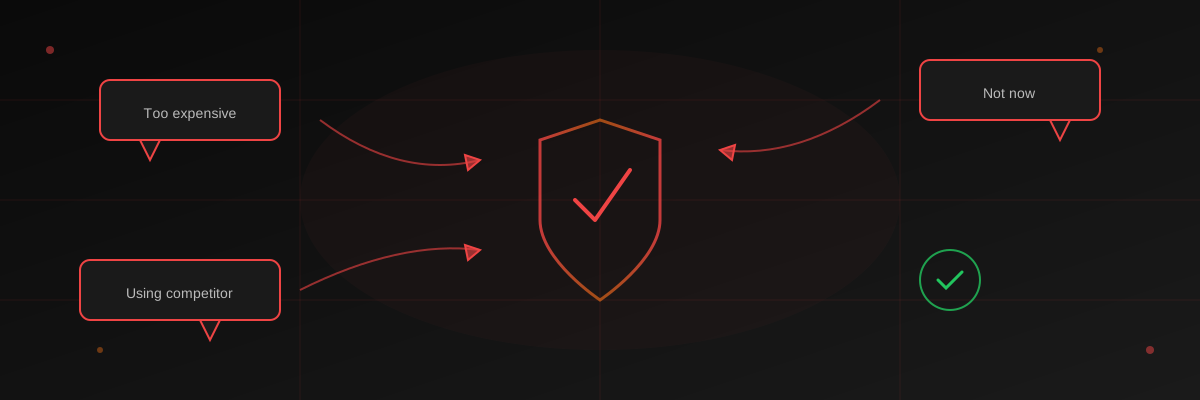
What This Playbook Covers
The psychology behind why prospects object and what they really mean
A proven framework for handling any objection without being defensive
Specific responses to the 10 most common B2B sales objections
How to preempt objections before they come up
When to push back vs. when to walk away
Role-play exercises to build objection-handling muscle memory
How to turn objections into opportunities to deepen the conversation
Before You Start
- • Active sales conversations (cold calls, discovery calls, or demos)
- • Understanding of your product's value proposition and differentiators
- • Knowledge of your competitive landscape
- • CRM to track objection patterns and outcomes
- • Willingness to practice and get uncomfortable
The Step-by-Step Process
Understand Why Prospects Object
Before you can handle objections effectively, you need to understand what they really are. Objections are not rejections—they're requests for more information, expressions of concern, or sometimes just reflexive responses. Most objections fall into four categories: lack of trust (they don't believe you can deliver), lack of need (they don't see the problem as urgent), lack of urgency (timing isn't right), and lack of budget (resources aren't available). The key insight is that objections are often symptoms, not root causes. When someone says 'It's too expensive,' they might really mean 'I don't see enough value to justify the cost' or 'I don't have budget authority' or 'I'm not convinced this will work.' Your job is to uncover the real concern, not just respond to the surface-level objection. The best salespeople welcome objections because they indicate engagement. A prospect who objects is a prospect who's thinking seriously about your offer. Silence or 'sounds good, let me think about it' is often worse than a clear objection—at least with an objection, you know what you're working with.
Example:
Surface objection: 'Your pricing is too high.' | Possible real concerns: 'I don't understand the ROI' | 'I don't have budget authority to approve this' | 'I'm comparing you to a cheaper competitor' | 'I'm not convinced this will actually work' | 'I need ammunition to justify this to my boss'
Master the LAER Framework
LAER stands for Listen, Acknowledge, Explore, Respond. This framework gives you a structured approach to any objection that keeps you from getting defensive or immediately trying to 'overcome' the concern. Listen: Let them finish completely. Don't interrupt, don't start formulating your response. Really hear what they're saying and how they're saying it. The emotion behind the objection often tells you more than the words. Acknowledge: Show that you heard them and that their concern is valid. This is not agreeing with them—it's validating that their perspective makes sense. 'I totally understand why you'd feel that way' or 'That's a fair concern, and you're not the first person to raise it.' Explore: This is where most reps skip ahead. Before you respond, dig deeper. Ask clarifying questions to understand the full picture. 'Help me understand—is that about the overall cost, or the cost relative to what you're expecting to get back?' or 'When you say the timing isn't right, what would need to change?' Respond: Only after you fully understand the objection should you respond. And your response should address what you learned in the Explore phase, not just a canned answer to the surface objection. The LAER framework prevents you from being defensive and shows the prospect you're genuinely trying to help, not just trying to close.
Example:
Objection: 'We're already working with another vendor.' | Listen: Let them finish, note their tone—are they firm or open? | Acknowledge: 'That makes sense—most companies in your space have something in place. Glad you're taking this seriously.' | Explore: 'Curious—how's that working out? What made you take this call if you're already covered?' | Respond: Based on what they share about gaps or frustrations with current vendor
Handle 'It's Too Expensive' Objections
Price objections are the most common and often the most mishandled. The natural instinct is to defend your pricing or offer a discount. Both are usually wrong. First, acknowledge the concern without getting defensive. 'I hear you—we're not the cheapest option out there.' Then explore what's behind the objection. Is it a budget constraint, a value perception issue, or a comparison to alternatives? 'Help me understand—is this about the total investment, or are you comparing us to something else?' If it's a value perception issue, you haven't done a good enough job connecting your solution to their specific pain. Go back to discovery: 'Let's step back—you mentioned earlier that [specific problem] is costing you [quantified impact]. If we can solve that, how does the investment look in that context?' If it's a budget constraint, explore timing and structure: 'If budget is the blocker, is this a matter of timing, or would a different payment structure help?' If they're comparing to a cheaper alternative, don't trash the competitor. Instead, help them think through total cost of ownership and fit: 'What's drawing you to that option? I want to make sure you're comparing apples to apples.' Never discount immediately. If you have to adjust pricing, get something in return—faster timeline, longer commitment, case study rights, introduction to peers. Discounting without getting something back trains prospects to always negotiate and devalues your solution.
Example:
Prospect: 'Honestly, this is more than we were expecting to spend.' | You: 'Fair enough—we're definitely not the budget option. Help me understand what you were expecting, and what's driving that number?' | Prospect: 'We had about $X in mind based on what we've seen.' | You: 'Got it. Out of curiosity—what would hitting your pipeline goals be worth? You mentioned you need to 3x meetings to hit revenue targets. If we deliver that, how does the investment look?' | If they still can't move: 'If budget is a hard constraint right now, let's talk about timing. When does your new fiscal year start?'
Handle 'We Need to Think About It' Objections
This is the objection that kills deals slowly. 'Let me think about it' or 'We need to discuss internally' often means one of three things: they don't see enough value to prioritize this, they have unspoken concerns they haven't shared, or they don't have authority to decide and don't want to admit it. Your job is to figure out which one it is—without being pushy. Start with acknowledgment: 'Totally makes sense—this isn't a small decision. I want to make sure you have everything you need.' Then get specific: 'What specifically do you want to think through? I want to make sure I've addressed everything.' This question is magic. It either surfaces the real objection or confirms they genuinely need processing time. If they name specific concerns, address them. If they can't articulate what they need to think about, it's often a sign they're not that interested or don't have authority. Test with: 'If you had everything you needed, is this something you'd want to move forward with?' A 'yes' with caveats tells you what to solve. A hesitant response tells you this might not be a real opportunity. Always leave with a specific next step. Not 'I'll follow up next week,' but 'Let's put 15 minutes on the calendar for Thursday to reconnect after you've had a chance to process. Does 2pm work?' If they won't commit to a next meeting, that's valuable information about deal priority.
Example:
Prospect: 'This is great—let me take this back to the team and think it over.' | You: 'Absolutely, I want you to be confident in whatever you decide. Quick question—what specifically do you want to run by the team? I want to make sure they have everything they need.' | Prospect: 'Mainly the budget and whether now is the right time.' | You: 'Got it. On budget—is that about approval, or about whether the investment makes sense given what we'd deliver? And on timing—what would make now the right time versus waiting?' | This either surfaces real objections to address or confirms the prospect is just stalling.
Handle 'We're Using a Competitor' Objections
When a prospect says they're already using someone else, many reps give up too easily or immediately trash the competitor. Both are mistakes. Being with a competitor means they've already acknowledged the need for what you sell—that's a good sign. Your job is to understand their satisfaction level and whether there's an opening. Start curious, not competitive: 'That's great—you're clearly taking this seriously. How's that working out for you?' Then listen carefully. Are they satisfied? Frustrated? Locked in? Every response opens a different path. If they're happy: 'Glad it's working. Out of curiosity, what made you take this call?' There's a reason they showed up—find it. If they're frustrated: 'What's not working?' Go deep on the gaps. These become your wedge. If they're locked in contractually: 'When does that come up for renewal? Let's stay in touch so you have options when the time comes.' Don't bash competitors—it makes you look insecure. Instead, ask questions that help the prospect discover the gaps themselves: 'How do they handle [thing you do better]?' or 'What's the process like when you need [area of your strength]?' Position yourself as the option for when things change, not as desperate for their business today. Some of the best deals come from prospects who switch after experiencing your competitor's limitations firsthand.
Example:
Prospect: 'We're actually already using [Competitor].' | You: 'Nice—they're solid in some areas. How's that going for you?' | Prospect: 'It's fine, but honestly the implementation was rocky and support isn't great.' | You: 'That's frustrating. How's that impacting your team day-to-day?' | Prospect: 'We spend more time than we should troubleshooting.' | You: 'If you could wave a magic wand, what would you want to be different?' | Listen and connect your differentiation to their specific frustrations.
Handle 'Now Isn't the Right Time' Objections
Timing objections feel like a wall, but they're often negotiable. The key is understanding whether timing is a real constraint or a polite brush-off. Acknowledge first: 'I get it—timing matters, and I don't want to push if this isn't the right moment.' Then explore: 'What would need to be true for the timing to be right?' or 'What's happening right now that's making this not a priority?' Their answer reveals everything. If it's budget cycles: 'When does your new budget year start? Let's get something in motion so you're ready to move when budget opens up.' If it's competing priorities: 'What's taking precedence? Curious how this stacks up against those priorities.' If it's bandwidth: 'Totally get it. What if we structure this so it requires minimal lift from your team?' Sometimes the timing objection is cover for other concerns. Test with: 'Setting timing aside for a second—if you had unlimited bandwidth and budget, is this something you'd want to do?' A 'no' means you have other objections to uncover. A 'yes' means you just need to solve for the timing constraint. For legitimate timing issues, don't disappear. Set up a specific time to reconnect: 'Let's put something on the calendar for [specific date] to revisit this. That way I'm not randomly pinging you, and you have a clear decision point.' Then actually follow up—most reps don't, and that's your advantage.
Example:
Prospect: 'I'm interested, but Q1 is insane for us. Can we revisit in Q2?' | You: 'Totally understand—Q1 is brutal in your world. Quick question: if we started setting things up now, light-touch, would you be able to hit the ground running when Q2 opens up? That way you don't lose momentum.' | Or: 'What's the Q1 crunch about? Just want to understand whether what we do might actually help with that vs. adding to your plate.'
Handle 'I Need to Talk to My Boss/Team' Objections
This objection often signals you're not talking to the decision-maker, or there's a buying process you need to navigate. The mistake is accepting it at face value and waiting passively for an answer. First, validate: 'Absolutely—decisions like this shouldn't be made in a vacuum.' Then get curious about the process: 'Walk me through how this decision will get made. Who else needs to be involved, and what will they care about most?' This gives you a map of the buying process and the stakeholders' priorities. Next, offer to help: 'Would it be useful for me to join that conversation, or put together something specific for [boss/team]? I've done this before and can usually help address questions that come up.' If they decline, arm them with what they need: 'What questions do you think they'll have? I want to make sure you have great answers.' You're essentially coaching them to sell internally for you. Also test whether they're bought in themselves: 'Before you take it to them—are you personally convinced this is the right move? If not, let's work through that first.' If they're not personally bought in, they won't be effective internal champions. Finally, create accountability: 'When are you planning to have that conversation? Can we schedule a quick follow-up for after so I can help with any questions that come up?' Don't let the deal go into a black hole.
Example:
Prospect: 'This looks good, but I need to run it by my VP.' | You: 'Of course—makes total sense. A couple questions: What does your VP care most about when evaluating something like this? And what do you think her concerns might be?' | Prospect: 'She's going to ask about ROI and implementation time.' | You: 'Perfect—I can put together an ROI analysis based on your specific numbers. On implementation, we can do a 2-week pilot before full rollout. Would that help address her concerns?' | Then: 'When are you meeting with her? Can we schedule 15 minutes for Friday so I can help with any questions she has?'
Preempt Objections Before They Arise
The best objection handling happens before objections come up. If you know your common objections (and you should), address them proactively in your sales process. Inoculation theory: When you bring up an objection yourself and address it, it becomes much less powerful when the prospect thinks of it later. 'You might be wondering about price—we're not the cheapest, and here's why that actually matters for your results...' Social proof preemption: Share stories of customers who had the same concern. 'A lot of our customers initially worried about implementation time. [Customer] had the same concern, and here's how we handled it...' Reframe before they frame: If you know prospects compare you to cheaper alternatives, address it early. 'You'll probably see options that cost less. Here's what we've seen happen with those, and why our customers choose us despite the price difference...' Build objection handling into your talk track: At each stage of your sales process, identify the likely objections and address them naturally in your presentation. This isn't about hiding concerns—it's about giving prospects confidence that you've thought through their worries. Track your objections: Keep a log of every objection you hear. Over time, patterns emerge. If 50% of prospects mention price, you probably need to do better upfront value-building. If many mention timing, your urgency creation needs work.
Example:
During demo: 'Before I show you the dashboard, I want to address something. A lot of folks wonder if this will integrate with their existing stack. We've built 50+ native integrations, and we haven't met a stack we couldn't work with. [Customer] had a complex Salesforce setup with custom objects—we were up and running in under a week. So that shouldn't be a blocker for you. Now let me show you...' | You've neutralized the integration objection before it could become a sticking point.
Know When to Walk Away
Not every objection should be overcome. Sometimes the right move is recognizing that this isn't a fit and walking away gracefully. This preserves your time, your reputation, and often creates a better long-term outcome than forcing a bad deal. Signs it's time to walk away: They genuinely don't have the problem you solve; Budget is a hard constraint with no path forward; Timeline is so far out that the opportunity cost isn't worth it; The champion doesn't have and can't get organizational support; They're price-shopping and will always go with the cheapest option. How to walk away well: Be direct but gracious. 'Based on what we've discussed, I'm not sure we're the right fit right now. You don't have the [problem we solve] urgently enough for this to make sense.' This does two things: it shows confidence and self-respect, and it often triggers the prospect to reconsider or at least leave with a positive impression. Plant seeds for the future: 'If things change—if [trigger event] happens—I'd love to reconnect. Okay if I check in next quarter?' Stay connected: Add them to your newsletter, connect on LinkedIn, keep the relationship warm. Circumstances change, and people remember salespeople who didn't waste their time. The irony: Sometimes walking away brings them back. Your willingness to not force a deal creates trust. We've had many prospects come back months later because they respected how we handled the initial no.
Example:
You: 'Sarah, I appreciate you being straight with me. Based on what you've shared—outbound isn't a priority until you hit certain revenue milestones, and budget isn't there right now—I don't think we're the right fit today. I'd rather be upfront about that than push for something that doesn't make sense for you.' | Prospect: 'I appreciate that.' | You: 'What I'd love to do: can I check back in 6 months when you're closer to those milestones? And in the meantime, I'll send you some content that might be useful as you think about this.' | This leaves a great impression and keeps the door open.
Practice Until It's Automatic
Objection handling is a skill that improves with deliberate practice. The goal is to make your responses automatic so you can focus on listening rather than thinking about what to say next. Role-play regularly: Schedule weekly practice sessions with teammates. One person plays the prospect and throws objections; the other practices LAER. Switch roles. This feels awkward at first but pays dividends in live conversations. Record your calls: Listen back to how you handle objections. Where did you get defensive? Where did you skip Explore and jump to Respond? What did you miss? Create an objection library: Document every objection you hear and your best response. Review and refine this library regularly. Share it with your team. Shadowing: Listen to how top performers on your team handle objections. Note specific phrases and techniques that work. Practice with AI: Use ChatGPT or similar tools to simulate sales conversations. Tell it to play a skeptical prospect and practice your responses. After every call: Spend 2 minutes reflecting. What objections came up? How did you handle them? What would you do differently? This is how you improve continuously. Build objection fluency: The best salespeople have heard every objection so many times that they respond naturally, with the right tone and framing. This fluency only comes from repetition. There's no shortcut.
Example:
Weekly practice routine: Monday 15 min—Review objection log from last week, note patterns | Wednesday 30 min—Role-play with teammate, focus on one objection type | Friday 15 min—Listen to one recorded call, note objection handling moments | After each call—2 min reflection: What objections? How handled? What to improve? | Monthly—Update objection library with new responses that worked
Pro Tips
Pause for 2-3 seconds before responding to any objection—it shows you're thinking, not just reacting
Write down objections as prospects say them—it shows you're taking them seriously and helps you remember the exact wording
Ask 'What else?' after handling an objection—there's often another concern beneath the surface
Use the prospect's exact words when you acknowledge and respond—it proves you listened
The tone of your response matters more than the words—confident and curious beats defensive and eager
Track objection-to-opportunity conversion rates by objection type to identify where you need more practice
When you hear a new objection, ask if you can follow up with a better answer—buying time is okay
Objections at the end of the sales process are often about risk—address underlying fears, not just stated concerns
What NOT to Do
- • Don't interrupt when the prospect is objecting—let them fully express the concern
- • Don't get defensive or take objections personally—they're about the situation, not you
- • Don't immediately try to overcome every objection—explore first
- • Don't trash competitors when handling comparison objections—it makes you look insecure
- • Don't offer discounts at the first mention of price—you'll train every prospect to negotiate
- • Don't accept 'let me think about it' without understanding what they need to think about
- • Don't argue with prospects—you might win the argument and lose the deal
- • Don't skip objection practice because it's uncomfortable—that's exactly why you need it
- • Don't assume you know what the objection really means—explore to confirm
- • Don't force a deal when walking away is the right move—bad deals cost more than no deals
Explore More Resources
Want Us to Run This Playbook For You?
Skip the learning curve. Let BookingBomb execute this at scale while you focus on closing.
Book Your Strategy Call