The Multi-Channel Outreach Playbook
Stop relying on a single channel. This playbook shows you how to orchestrate email, LinkedIn, phone, and other channels into a cohesive outbound motion that dramatically increases response rates.
Time to Execute
2-3 weeks setup
Difficulty
Medium-Hard
Expected Result
2-3x higher response rates vs. single channel
What This Playbook Covers
Why multi-channel outreach dramatically outperforms single-channel approaches
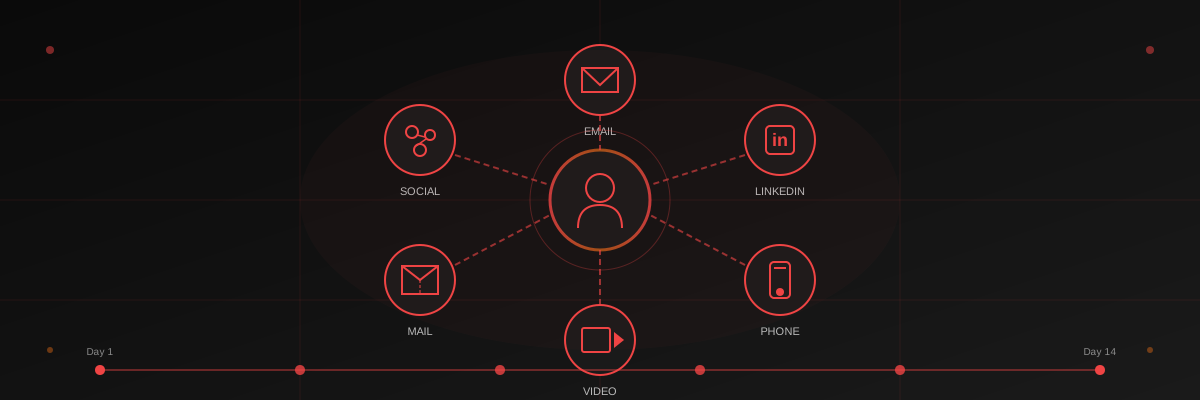
How to build an orchestrated sequence across email, LinkedIn, phone, and other channels
The optimal timing and cadence for multi-channel touches
Channel-specific best practices that make each touchpoint effective
How to track and attribute responses across channels
Avoiding the spam trap—staying coordinated without being annoying
Technology stack recommendations for multi-channel execution
Before You Start
- • Existing outbound motion (even if single-channel) with baseline metrics
- • Clean prospect data with email, phone, and LinkedIn information
- • Sales engagement platform (Outreach, Salesloft, or similar)
- • LinkedIn Sales Navigator account
- • Call capability (phone or VoIP)
- • CRM to track multi-channel activity
The Step-by-Step Process
Understand Why Multi-Channel Works
Single-channel outreach is fundamentally limited. Not everyone checks email religiously. Not everyone answers the phone. Not everyone is active on LinkedIn. When you rely on one channel, you're automatically missing the prospects who prefer other channels. Multi-channel outreach works because: It meets prospects where they are. Some people are email-first, others live on LinkedIn, others actually answer their phone. By reaching out across channels, you dramatically increase the odds of connecting. It creates repetition without annoyance. Seeing a name once is forgettable. Seeing the same name across email, LinkedIn, and voicemail—with consistent, relevant messaging—creates recognition and credibility. It demonstrates effort. When a prospect sees coordinated outreach across channels, they recognize you're serious and have done your homework. That effort stands out in a world of lazy automation. It increases touchpoint surface area. Five emails is five touches. Two emails + two LinkedIn messages + one call + one voicemail is still five touches, but across multiple channels—each with different strengths. The data backs this up: Multi-channel sequences consistently see 2-3x higher response rates than single-channel approaches. The investment in coordination pays off in dramatically better outcomes.
Example:
Single-channel (email only): 5 emails over 14 days = 8% response rate | Multi-channel (same effort): 2 emails + 2 LinkedIn touches + 1 call = 18-24% response rate | Why: You reached the prospect who never checks cold emails but always responds to LinkedIn. You caught the executive who only engages with people who call. You built familiarity across channels that made your final email feel like a warm touch, not cold outreach.
Map Your Channel Mix
Before building sequences, understand the role each channel plays. Every channel has strengths and weaknesses—the art is combining them strategically. Email: Highest volume capacity, lowest per-touch effort, easy to personalize at scale. Weakness: Overcrowded inboxes, deliverability challenges, easy to ignore. Best for: Detailed value props, sharing content, follow-ups. LinkedIn: High open rates, professional context, ability to see mutual connections and shared experiences. Weakness: Limited message length, platform restrictions on automation, can feel intrusive. Best for: Initial connection, casual conversation starters, content engagement. Phone: Highest conversion when you connect, real-time conversation, ability to handle objections immediately. Weakness: Low connect rates (especially with executives), time-intensive, requires confidence. Best for: Following up on engagement signals, reaching decision-makers, complex situations. Voicemail: Extends phone's reach, creates additional touchpoint, voice humanizes you. Weakness: Rarely returned, needs to be concise. Best for: Reinforcing other touches, sharing one compelling reason to call back. Video: Highly differentiated, shows personality and effort, great for complex messages. Weakness: Time-consuming to create, requires good production. Best for: High-value prospects, standing out in crowded sequences. Direct mail: Cuts through digital noise, tangible and memorable. Weakness: Expensive, slow, logistics complexity. Best for: Executive outreach, high-value accounts, standing out. Your channel mix depends on your target audience, resources, and what you're selling. Enterprise deals might justify video and direct mail. High-volume plays might focus on email + LinkedIn + phone.
Example:
Channel mix for enterprise SaaS targeting VPs: Primary channels: Email (foundation), LinkedIn (connection and warmth), Phone (high-intent follow-up) | Secondary channels: Video (for top 20% of prospects), Direct mail (for top 5% / stuck opportunities) | Not using: SMS (too intrusive for this audience), Chat (prospects not typically on our site) | Channel allocation: 40% email, 30% LinkedIn, 20% phone, 10% video/mail
Design Your Multi-Channel Sequence
Now build the actual sequence. The key is orchestration—each touch should build on the previous ones, not feel like random noise. Week 1: Lead with your highest-engagement channels to establish recognition. Day 1: Email #1 (personalized opening, clear value prop), LinkedIn connection request (short, relevant note). Day 3: LinkedIn message (if connected) or engage with their content, Email #2 (different angle, shorter). Day 5: Phone call + voicemail, Email #3 (reference you called, ask if better time). Week 2: Intensify and vary the approach. Day 8: LinkedIn message (share relevant content), Video message (for high-priority prospects). Day 10: Email #4 (case study or social proof), Phone call #2. Day 12: LinkedIn voice note (highly differentiated), Email #5 (direct ask). Week 3: Final push with breakup framing. Day 15: Email #6 (breakup email framing), Phone call #3 + voicemail. Day 18: LinkedIn final message (leave door open). The exact timing depends on your audience and sales cycle. Shorter cycles might compress this. Longer, complex sales might extend it. Personalization should thread through. Reference previous touches: 'Left you a voicemail earlier—wanted to follow up here too.' This shows coordination, not randomness.
Example:
14-Day Multi-Channel Sequence: Day 1: Email #1 (personalized value prop) + LinkedIn connect (short note) | Day 2: LinkedIn content engagement | Day 3: Email #2 (case study) | Day 5: Phone + voicemail | Day 6: LinkedIn message (if connected) | Day 8: Email #3 (reference call) | Day 10: Video message (high-priority) OR LinkedIn voice note | Day 12: Phone + voicemail #2, Email #4 | Day 14: Breakup email + LinkedIn final
Master Channel-Specific Execution
Each channel has its own best practices. Executing well on each touch maximizes the multi-channel effect. Email best practices: Keep subject lines under 5 words. Lead with the prospect, not yourself. One clear CTA per email. 75-125 words max. Use plain text over HTML for cold outreach. Personalize the first line specifically to the recipient. LinkedIn best practices: Connection requests under 300 characters. Messages should feel conversational, not formal. Engage with their content before messaging. Use voice notes for differentiation (they get 5x response rates). Don't pitch immediately—start conversations. Phone best practices: Call early morning (7-8am) or late afternoon (4-6pm) when gatekeepers are gone. Stand up when you call—it improves your energy. Have a clear 15-second opener. Aim to get a conversation, not deliver a pitch. If you leave a voicemail, keep it under 30 seconds with one clear reason to call back. Video best practices: Keep videos under 60 seconds. Start with their name and company visible (shows it's not a mass blast). Get to the point quickly—don't waste time on intro. Use a casual, conversational tone. Tools like Loom or Vidyard make this easy. Direct mail best practices: Send something relevant, not generic swag. Include a handwritten note. Time it to arrive mid-week. Follow up within 48 hours referencing the package. For executives, books related to their challenges work well. Quality over channel quantity: Better to do fewer channels exceptionally than many channels poorly. Start with email + LinkedIn + phone and master those before adding video or direct mail.
Example:
LinkedIn voice note script (under 60 seconds): 'Hey Sarah, quick voice note because I know these stand out. Saw your post about scaling the SDR team—the bit about quality over quantity really resonated. We've been helping a few other fintech companies in exactly that position, and I had a thought that might be useful. No pitch—just thought it could be a valuable 15-minute conversation. Send me a message if you're open to it, or I'll follow up later this week. Talk soon.'
Time and Pace Your Touches
Timing matters as much as content. Poor timing turns coordinated outreach into annoying spam. Daily limits: Don't hit the same prospect across multiple channels on the same day unless you have a specific reason (like following up on an engagement signal). One touch per day maximum is a good rule. Spacing: Leave 2-3 days between touches as a baseline. Compress slightly (1-2 days) for time-sensitive outreach or after engagement signals. Extend to 4-5 days in the latter half of sequences to avoid fatigue. Channel rotation: Vary the channel each day rather than batching. Email, then LinkedIn, then phone—not three emails then three LinkedIn messages. Variation maintains interest. Time of day: Different channels work at different times. Email: Tuesday-Thursday, 8-10am or 2-4pm in prospect's timezone. LinkedIn: Slightly broader—weekday business hours generally work. Phone: Early morning (7-8am) or late afternoon (4-6pm) typically has highest connect rates. Respect the no: If someone asks you to stop, stop across all channels immediately. One person complaining about spam can damage your domain and LinkedIn account. Watch for diminishing returns: Track response rates by touch number. If you're getting 80% of responses in the first 5 touches, an 8-touch sequence may not be worth the effort and risk.
Example:
Touch pacing example: Day 1 (Tuesday 9am): Email #1 | Day 2 (Wednesday 8am): LinkedIn connect | Day 4 (Friday 3pm): Email #2 | Day 5 (Monday 7:30am): Phone call | Day 8 (Thursday 10am): LinkedIn message | Day 10 (Monday 4pm): Phone call #2 | Day 12 (Wednesday 9am): Email #3 | Day 14 (Friday 8am): Breakup email + LinkedIn final message | Notice: Never same channel back-to-back, spacing increases slightly in later touches, mix of days/times
Track and Attribute Multi-Channel Activity
Multi-channel outreach is harder to track than single-channel, but measurement is essential for optimization. Unified tracking: Use a sales engagement platform that tracks activity across channels in one place. You need to see the full prospect journey, not siloed email vs. LinkedIn vs. phone reports. Account-level view: Don't just track by contact—track by account. You might reach three people at a company across different channels before one responds. Account-level tracking shows the full picture. Attribution approach: Multi-channel makes last-touch attribution misleading. The LinkedIn message that got the response may have only worked because of the three emails before it. Use sequence-level attribution—credit the whole sequence, not individual touches. Key metrics to track: Overall response rate by sequence, Response rate by touch number (which touches drive responses?), Response rate by channel (where do responses come from?), Connect rate on phone, Connection acceptance rate on LinkedIn, Positive response rate (responses that advance the conversation), Meeting booked rate, Time to response (faster indicates better engagement). Compare to baselines: Track multi-channel performance against your single-channel baselines. If you were getting 10% response rates on email-only and 22% on multi-channel, you can justify the additional effort. A/B test sequences: Test different channel mixes, different orders, different timing. Run cohorts through different sequences and compare results. The data will show you what works for your specific audience.
Example:
Multi-channel tracking dashboard: Sequence: Q1 Enterprise Multi-Channel | Contacts enrolled: 500 | Responses: 98 (19.6%) | By touch: Email #1 (4%), LinkedIn connect (6%), Email #2 (3%), Phone (2%), LinkedIn message (2%), Email #3 (1.5%), Breakup (1.1%) | By channel: Email 43%, LinkedIn 41%, Phone 16% | Positive responses: 71 (14.2%) | Meetings booked: 34 (6.8%) | Insight: LinkedIn driving more responses than expected—test increasing LinkedIn touches in next sequence
Avoid the Spam Trap
There's a fine line between coordinated multi-channel outreach and being annoyingly omnipresent. Stay on the right side. Coordination, not bombardment: Your touches should feel connected, not like separate campaigns attacking from all angles. Reference previous touches. Build a coherent narrative. Personalization is protection: Generic multi-channel outreach feels like spam. Personalized multi-channel outreach feels like effort. The difference is in the details—specific references to their situation, not just their name. Respect engagement signals: If someone opens an email but doesn't respond, that's not an invitation to hit them harder. If they click a link, engage with your LinkedIn post, or listen to your voicemail, adjust your follow-up accordingly—acknowledge the engagement. Quality thresholds: If your messaging isn't good enough for one channel, it's not good enough for multiple channels. Multi-channel amplifies whatever you're putting out. Make sure it's worth amplifying. Monitor complaints: Track spam complaints, LinkedIn connection denials, and phone hang-ups. If these spike, something in your approach needs to change. One complaint is one too many if it triggers broader consequences. The breakup gives closure: Your final touch should acknowledge that you've reached out multiple times and leave the door open gracefully. This shows self-awareness and prevents the 'stalker' perception. Don't automate engagement: Automated LinkedIn likes, comments, and endorsements are obvious and creepy. Keep engagement genuine even if outreach is systematized.
Example:
Red flags you've crossed into spam: Same prospect complaining on LinkedIn about your outreach | Multiple people at same company asking to be removed | LinkedIn restricting your account for 'commercial use' | Email domain landing on blocklists | Sales team reporting prospects mentioning 'we've heard from you a lot' | Response rate declining as sequence progresses (fatigue signals) | Actions if you see these: Reduce touch frequency, improve personalization, check message quality, ensure you're targeting appropriate prospects
Build Your Tech Stack
Multi-channel execution requires tools that work together. Here's the technology stack that enables coordinated outreach at scale. Sales engagement platform (essential): Outreach, Salesloft, Apollo, or similar. This is your command center—where you build sequences, track activity, and manage prospect communication across email and phone. Choose one and master it. LinkedIn tools: Sales Navigator (essential for targeting and research), LinkedIn's native messaging, and optionally tools like Lavender (for message coaching) or Shield (for analytics). Be cautious with automation tools—LinkedIn is aggressive about enforcement. Phone/dialer: Most sales engagement platforms include a dialer. If not, tools like Aircall, Kixie, or RingCentral integrate well. Key features: click-to-dial from CRM, voicemail drop, call recording. Video: Loom or Vidyard for recording and sending personalized videos. Both integrate with email and provide viewing analytics. CRM: HubSpot, Salesforce, or Pipedrive. Your CRM is the source of truth for account and contact data and where activity should ultimately sync. Direct mail: Sendoso, Postal, or Alyce if you're doing physical mail at scale. These handle logistics and integrate with your workflow. Integration is everything: Your tools need to talk to each other. Activity should flow to CRM automatically. Sales engagement platform should pull data from CRM. Ideally, you can see LinkedIn activity alongside email and call activity in one place. Avoid tool sprawl: More tools create more complexity and more places for things to break. Start lean and add tools only when you've hit specific limitations.
Example:
Recommended stack (mid-market B2B): CRM: HubSpot (source of truth) | Sales engagement: Outreach (sequences, email, phone, analytics) | LinkedIn: Sales Navigator (research + targeting) | Video: Loom (personalized videos) | Integration: Native HubSpot-Outreach integration, manual LinkedIn activity logging | Total: 4 tools, all integrated | Estimated cost: $400-600/rep/month | Stack for early-stage/bootstrap: CRM: HubSpot free | Sales engagement: Apollo (includes email + phone) | LinkedIn: Basic Sales Navigator | Video: Loom free | Total: ~$150/rep/month
Scale and Iterate
Once your multi-channel motion is working, scale it systematically while continuing to optimize. Start small: Pilot with a subset of prospects (50-100) before rolling out to your full list. Work out the kinks in messaging, timing, and process on a manageable sample. Build playbooks: Document your sequence structure, channel-specific scripts, timing rules, and personalization guidelines. These playbooks enable team scaling and ensure consistency. Train your team: Multi-channel execution requires more skill than single-channel. Train reps on channel-specific best practices, when to deviate from sequences based on signals, and how to track activity properly. Create feedback loops: Meet weekly to discuss what's working and what isn't. Share winning messages, discuss failed experiments, and continuously update your playbooks based on learnings. A/B test continuously: Always have a test running. Different subject lines, LinkedIn message tones, call times, sequence length—systematic testing is how you improve. Segment and customize: As you scale, create segment-specific sequences. Enterprise prospects might get more touches and higher-effort content. SMB might get shorter, more automated sequences. Different industries might warrant different messaging. Monitor at scale: As volume increases, keep watching key metrics. Response rates, complaint rates, and deliverability all need ongoing attention. Small issues at low volume become big problems at scale. Know when to evolve: Multi-channel best practices change. Channels that work today may be saturated next year. Keep experimenting with new channels (SMS, WhatsApp, podcast sponsorships, community engagement) while mastering the fundamentals.
Example:
Multi-channel scaling timeline: Month 1: Pilot with 50 prospects, 1 rep, single sequence. Focus: Get foundational sequence working, establish baseline metrics. | Month 2: Expand to 200 prospects, 2 reps, add segment variations. Focus: Train second rep, create playbooks, start A/B testing. | Month 3: Full rollout to team, 500+ prospects, multiple sequence variants. Focus: Team training, process refinement, continuous optimization. | Ongoing: Weekly reviews, monthly sequence refreshes, quarterly channel mix evaluation
Pro Tips
Start your sequence with email—it's the easiest channel to personalize at scale and establishes context for other touches
LinkedIn voice notes get 5x the response rate of text messages—use them liberally, especially mid-sequence
Reference previous touches in your messaging: 'Following up on my email and voicemail...' shows coordination
Use 'task' steps in your sequence for manual LinkedIn engagement—liking or commenting on posts before messaging
Phone connects spike on the first day back after holidays and long weekends—plan call blocks accordingly
If someone engages on one channel (opens email, accepts connection), prioritize that channel for immediate follow-up
Create template variations and rotate them to avoid pattern detection by spam filters and LinkedIn
Video works best mid-sequence when you've built some familiarity but need to break through
Time your direct mail to arrive Tuesday-Wednesday—Monday mail gets buried, Friday mail gets forgotten
What NOT to Do
- • Don't hit prospects on multiple channels the same day—it feels like an attack, not outreach
- • Don't automate LinkedIn engagement (likes, comments, endorsements)—it's obviously fake and can get you banned
- • Don't use the same message across channels—adapt the message for the medium
- • Don't skip personalization because you're doing multiple touches—generic multi-channel is worse than generic single-channel
- • Don't ignore channel-specific limits (LinkedIn connection limits, email sending limits)—getting restricted kills your outreach
- • Don't add channels just to add channels—only use channels you can execute well
- • Don't forget to track at the account level, not just contact level—the response might come from someone you didn't email directly
- • Don't send video as your first touch—it's better after you've established some context
- • Don't give up on phone just because connect rates are low—when you do connect, conversion rates are highest
- • Don't blast through sequences without checking for engagement signals—adjust based on what prospects are doing
Explore More Resources
Want Us to Run This Playbook For You?
Skip the learning curve. Let BookingBomb execute this at scale while you focus on closing.
Book Your Strategy Call