The Account-Based Marketing (ABM) Playbook
The complete ABM playbook for B2B companies targeting enterprise accounts. Align sales and marketing to win your highest-value target accounts with personalized, multi-channel campaigns.
Time to Execute
4-6 weeks initial setup
Difficulty
Hard
Expected Result
3-5x higher deal values from target accounts
What This Playbook Covers
How to identify and prioritize high-value target accounts
Building account research and intelligence processes
Creating personalized content and messaging for target accounts
Orchestrating multi-channel campaigns that reach buying committees
Aligning sales and marketing around account goals
Measuring ABM success beyond traditional metrics
Scaling ABM from pilot to full program
Before You Start
- • Clear understanding of your ideal customer profile (ICP)
- • Average deal size of $25K+ (ABM is resource-intensive)
- • Sales and marketing alignment on target account strategy
- • CRM with good account-level data hygiene
- • Content resources (or budget to create account-specific content)
- • Executive buy-in for a long-term strategy (ABM takes 6-12 months to show full results)
The Step-by-Step Process
Define Your Target Account List
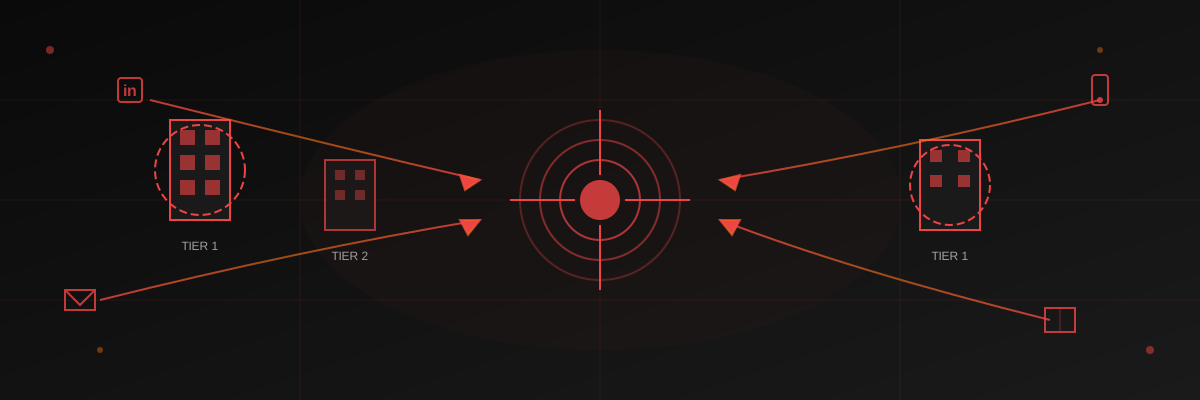
ABM success starts with targeting the right accounts. Cast too wide a net and you're just doing regular marketing. Too narrow and you don't have enough pipeline. Most B2B companies should start with 50-100 target accounts for their first ABM program. Start with data: Pull accounts that match your ICP criteria—industry, company size, tech stack, funding stage, growth signals. Look at your best existing customers and find their lookalikes. Firmographic fit is table stakes; you also want signals of readiness—recent funding, executive hires, technology changes, or public statements about priorities you can help with. Layer in engagement data: Which accounts are already visiting your site, engaging with content, or showing intent signals on third-party platforms? These warm accounts should be prioritized. Create tiers: Not all target accounts deserve the same resources. Tier 1 (10-20 accounts) gets fully personalized 1:1 treatment. Tier 2 (30-50 accounts) gets segment-specific personalization. Tier 3 (remaining) gets industry-level personalization. Validate with sales: Your target account list must be co-created with sales. They have context on relationships, timing, and fit that data alone won't capture. If sales doesn't believe in the list, the program is dead on arrival. Review and refresh quarterly: Target accounts aren't static. Some will become customers, some will disqualify themselves, and new companies will emerge that deserve attention.
Example:
Target Account Criteria: Industry: B2B SaaS, Fintech, Healthcare Tech | Size: 200-2000 employees | Funding: Series B+ or profitable | Tech stack: Using Salesforce + outbound tools | Intent signals: Researching sales engagement or outbound solutions | Tier assignment: Tier 1: 15 accounts (personalized everything) | Tier 2: 40 accounts (segment personalization) | Tier 3: 75 accounts (industry personalization)
Build Account Intelligence
ABM is only as good as your account research. You need to understand each target account deeply—their business, challenges, buying committee, and what would actually motivate them to engage. Company research: What does the business do? What are their strategic priorities? What challenges are they facing? Look at their website, press releases, earnings calls (if public), LinkedIn company page, and recent news. Industry context: What macro trends affect their business? What are their competitors doing? This helps you speak their language. Buying committee mapping: Who are the people you need to influence? In enterprise deals, you're selling to a committee, not an individual. Identify the economic buyer, user buyers, technical evaluators, and internal champions. Use LinkedIn, your CRM, and tools like ZoomInfo to build this map. Individual research: For key contacts, go deeper. What do they post about on LinkedIn? What podcasts have they been on? What's their professional background? This fuels personalization. Technology and vendor research: What solutions do they currently use? Understanding their tech stack reveals integration opportunities and competitive displacement angles. Create account briefs: Synthesize your research into 1-page account briefs that sales and marketing can use. Include: company overview, strategic priorities, key contacts, relevant pain points, personalization angles, and recommended tactics.
Example:
Account Brief - Acme Corp: Overview: Series C fintech, 500 employees, provides payment infrastructure for e-commerce | Strategic priorities: International expansion, enterprise upmarket motion (per CEO interview) | Key challenges: Scaling sales team to match growth, struggling with outbound (per VP Sales LinkedIn posts) | Buying committee: VP Sales (Sarah Chen) - likely economic buyer, Dir of Revenue Ops (Mike Johnson) - technical evaluator, CEO (founder-led sales involvement) | Tech stack: Salesforce, Outreach, ZoomInfo | Pain points we address: Outbound efficiency, meeting quality, scaling without proportional headcount | Personalization angles: Sarah's recent post about 'quality over quantity' in pipeline, their Series C announcement emphasizing GTM investment
Create Account-Specific Content and Messaging
Generic content doesn't work in ABM. Your messaging needs to demonstrate that you understand each account's specific situation and can help with their specific challenges. For Tier 1 accounts, create fully custom content: personalized landing pages, custom one-pagers, account-specific case studies (featuring similar companies), personalized video messages, custom ROI analyses. This is resource-intensive but these are your highest-value opportunities. For Tier 2 accounts, create segment-specific content: landing pages for their industry vertical, case studies from similar companies, messaging that addresses their segment's common challenges. Personalize the delivery even if the content isn't fully custom. For Tier 3 accounts, use smart personalization at scale: industry-specific content, dynamic website experiences based on firmographic data, templated outreach with personalization variables. All content should answer: 'Why you, why now, why us?' Why them specifically should engage. Why now—what's the urgency. Why you—what makes you the right choice. Messaging should focus on outcomes, not features. Connect your capabilities to their specific business objectives. If they're focused on international expansion, talk about how you've helped similar companies expand globally—not your product's features.
Example:
Tier 1 Account Content (Acme Corp): Custom landing page: 'How BookingBomb Helps Fintech Companies Scale Outbound for International Expansion' | Personalized video: 60-second Loom from AE addressing Sarah Chen's LinkedIn post about quality pipeline | Custom ROI calculator: Pre-filled with estimates based on their sales team size and growth targets | Account-specific case study: 'How [Similar Fintech] 4x'd Enterprise Pipeline While Maintaining Quality' | Custom one-pager: Addressing payment infrastructure companies' unique outbound challenges
Orchestrate Multi-Channel Campaigns
ABM is not just personalized email. It's surrounding your target accounts with relevant messages across every channel where they're active—creating the impression that you're everywhere (because you understand them deeply). The channel mix typically includes: Direct mail: Physical items cut through digital noise. Send relevant books, custom swag, or creative packages to key contacts. Not cheesy—thoughtful and tied to their interests or challenges. LinkedIn: Ads targeting the buying committee, personalized connection requests, content engagement, InMails (sparingly). Email: Personalized sequences from sales, marketing nurtures, event invitations. Make sure sales and marketing aren't both emailing the same person with conflicting messages. Display advertising: Retargeting and account-based display ads that reinforce messaging and keep you top of mind. Content syndication: Getting your thought leadership in front of target accounts through publications they read. Events: Webinars designed for their segment, invitations to dinners or executive events, conferences they attend. Phone: Yes, cold calling is still part of ABM. Coordinate with digital touches for maximum impact. The key is orchestration—these channels should work together, not independently. A prospect might see your LinkedIn ad, receive a thoughtful direct mail piece, get a personalized email referencing the mailer, and then get a call. Each touch builds on the last. Create a campaign calendar that maps out touches across channels over 4-8 weeks. Ensure sales and marketing are synchronized so outreach feels coordinated, not chaotic.
Example:
8-Week Tier 1 Campaign for Acme Corp: Week 1: LinkedIn ads start running to buying committee, sales connects with Sarah Chen on LinkedIn | Week 2: Direct mail package arrives (book on scaling sales teams with personalized note), marketing sends email to ops contacts about integration | Week 3: Personalized email from AE referencing the book, LinkedIn ad creative updated | Week 4: Invite to exclusive virtual roundtable with similar companies | Week 5: Follow-up call from AE, retargeting ads intensify | Week 6: Second direct mail (case study + custom one-pager) | Week 7: Video email from AE, LinkedIn engagement with their content | Week 8: Executive outreach (VP to VP), call to discuss roundtable insights
Align Sales and Marketing Execution
ABM fails when sales and marketing operate in silos. True alignment means shared goals, shared accounts, shared intelligence, and coordinated execution. Shared goals: Both teams should be measured on the same outcomes—target account engagement, pipeline from target accounts, revenue from target accounts. If marketing is measured on MQLs and sales on closed revenue, you're not aligned. Shared account ownership: Assign specific accounts to specific sales reps and marketing counterparts. Create clear ownership so nothing falls through the cracks and efforts aren't duplicated. Regular syncs: Weekly (at minimum) meetings between sales and marketing to review account activity, share intelligence, adjust tactics. What's working? What's not? What did we learn from conversations? Shared intelligence: When sales has a call with a target account, that intelligence should flow to marketing immediately. When marketing sees engagement signals, sales should know within hours, not weeks. Build this into your process. Unified tech stack: Sales and marketing should be working from the same data. CRM, marketing automation, and sales engagement tools should be connected so everyone sees the full picture of account engagement. Playbooks: Create clear playbooks for how sales and marketing work together on ABM. Who reaches out first? What triggers a sales call? How do we handle different response scenarios? Executive sponsorship: ABM alignment requires leadership support. If sales and marketing leadership aren't publicly aligned and regularly reinforcing the partnership, ground-level alignment will erode.
Example:
ABM Operating Rhythm: Daily: Slack channel for target account intelligence sharing | Weekly: 30-min ABM sync (sales and marketing) reviewing hot accounts, stuck accounts, campaign performance | Monthly: ABM pipeline review with sales and marketing leadership | Quarterly: Target account list refresh, program retrospective, strategy adjustments | Trigger-based: When target account hits engagement threshold, automatic Slack notification to assigned rep with context
Measure ABM Success
Traditional marketing metrics don't work for ABM. You're optimizing for account penetration and deal progression, not lead volume. The metrics that matter: Account engagement score: A composite metric measuring how actively target accounts are engaging with your brand—website visits, content downloads, email engagement, ad clicks, event attendance. Track this at the account level, not individual level. Coverage: What percentage of the buying committee at target accounts have you reached? If you're only engaging one person per account, you're vulnerable. Penetration: How many target accounts have entered your pipeline? What's the conversion rate from target account to opportunity? Pipeline from target accounts: Total pipeline value attributed to target accounts vs. non-target accounts. This should be significantly higher for ABM accounts. Deal velocity: How fast do target account deals move through your pipeline compared to non-target accounts? ABM should accelerate deals. Average deal size: Target account deals should be larger due to better qualification and multi-threaded relationships. Win rate: Are you winning target account deals at a higher rate than non-ABM deals? Revenue from target accounts: The ultimate metric—what revenue is ABM driving? Build dashboards: Create dashboards that show account-level metrics, not just lead or contact metrics. Most out-of-the-box reporting won't work; you'll need to build custom reports. Attribution approach: ABM involves many touches; don't try to attribute to single channels. Focus on whether accounts are progressing, not which specific touch gets credit.
Example:
ABM Dashboard Metrics: Account engagement: Score 1-100 based on weighted activities (site visits, content downloads, email engagement, call completions) | Coverage: % of target accounts with 3+ contacts engaged | Penetration: % of target accounts with active opportunities | Pipeline: $X pipeline from target accounts (vs. $Y from non-target) | Velocity: Target account deals close in X days (vs. Y days for non-target) | Win rate: X% for target accounts (vs. Y% for non-target) | Revenue: $X closed from target accounts this quarter
Scale from Pilot to Full Program
Don't try to boil the ocean. Start with a pilot program, prove results, then scale what works. Pilot phase (months 1-3): Start with 10-20 Tier 1 accounts. Go deep, not wide. Test your account selection criteria, content approaches, and channel mix. Learn what resonates and what doesn't. Focus on process development as much as results. Validate phase (months 4-6): Expand to your full Tier 1 list and start Tier 2. Apply learnings from the pilot. Refine your account scoring and engagement tracking. Start building the playbooks and templates you'll need to scale. Scale phase (months 7-12): Expand to full target account list. Build efficient processes for Tier 2 and 3 that require less manual effort. Invest in technology to automate personalization at scale. Hire dedicated ABM resources as the program proves ROI. Continuous optimization: ABM is never 'done.' Regularly refresh target accounts, test new channels and tactics, improve personalization, and tighten sales-marketing alignment. Don't skip the pilot. The temptation is to go big immediately, but ABM has many moving parts. Pilots let you fail cheaply and learn quickly. Budget for the long term: ABM takes 6-12 months to show full results. Make sure stakeholders understand this isn't a quick fix and that success builds over time.
Example:
12-Month ABM Scaling Plan: Months 1-3 (Pilot): 15 Tier 1 accounts, 2 dedicated team members, focus on process and learning, success = engagement and pipeline from pilot accounts | Months 4-6 (Validate): Full Tier 1 (25 accounts) + 50 Tier 2 accounts, add 1 team member, success = repeatable playbooks, pipeline growth from target accounts | Months 7-12 (Scale): Full program (150 accounts across tiers), add technology (intent data, personalization platform), dedicated ABM team (2-3 people), success = meaningful revenue from target accounts, proven ROI case for continued investment
Pro Tips
Start with accounts where you already have a warm relationship or entry point—your first wins should be low-hanging fruit
Use intent data to identify accounts actively researching your category—they're more likely to engage
Don't underestimate direct mail—response rates are often 5-10x digital channels because so few companies do it well
Build a 'listen' layer into your program—track target account job postings, news, and social activity for real-time personalization triggers
Create an internal account update newsletter so everyone in the company knows the status of top target accounts
Involve your customer success team—existing relationships at target accounts can provide warm introductions
Time your campaigns around budget cycles—Q4 planning season is often the best time to engage with next year's initiatives
Use LinkedIn's matched audiences feature to serve ads specifically to employees at your target accounts
What NOT to Do
- • Don't target too many accounts—ABM is resource-intensive, and spreading too thin kills the program
- • Don't do ABM without sales alignment—marketing-only ABM is just expensive advertising
- • Don't expect quick results—ABM deals take months to develop; set expectations accordingly
- • Don't treat ABM as just another demand gen channel—it requires different metrics and patience
- • Don't ignore existing relationships—leveraging current customers for intros to target accounts is hugely valuable
- • Don't skip the research—personalization without insight feels creepy and hollow
- • Don't automate too early—understand what works manually before building efficient processes
- • Don't measure ABM with traditional lead metrics—account-level metrics are what matter
- • Don't let technology replace strategy—ABM platforms are tools, not strategies
- • Don't give up after 3 months—ABM compounds over time
Explore More Resources
Want Us to Run This Playbook For You?
Skip the learning curve. Let BookingBomb execute this at scale while you focus on closing.
Book Your Strategy Call