Lead to Opportunity Conversion Benchmarks
What percentage of leads should convert to qualified opportunities? We analyzed funnel data across B2B companies to establish conversion benchmarks by lead source, industry, and company size.
The Number That Matters
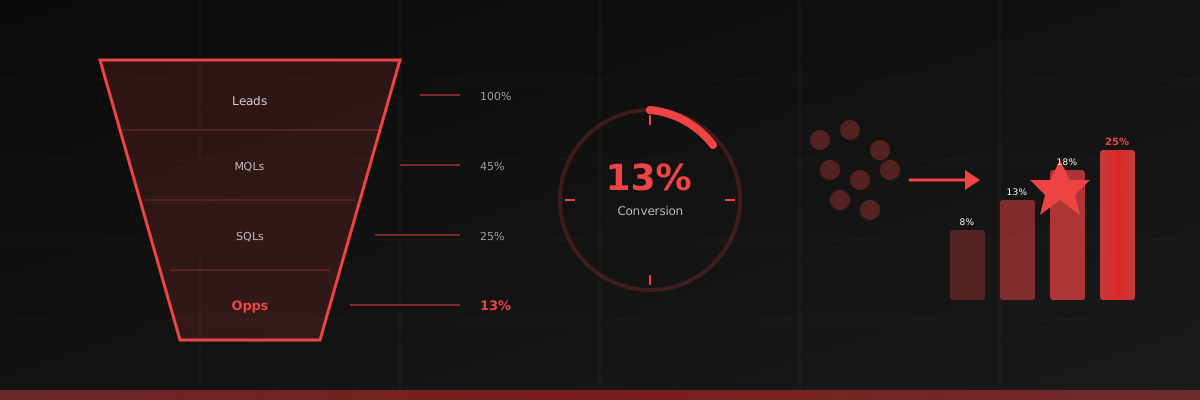
13%
Average Lead to Opportunity Conversion Rate
The Numbers
| Category | Poor | Average | Good | Excellent |
|---|---|---|---|---|
| Inbound Marketing Leads | <8% | 12-18% | 20-28% | >32% |
| Outbound Prospecting | <3% | 5-9% | 10-15% | >18% |
| Referral Leads | <20% | 30-40% | 42-55% | >60% |
| Event/Webinar Leads | <6% | 10-16% | 18-25% | >30% |
| Partner/Channel Leads | <12% | 18-26% | 28-38% | >42% |
| Website Demo Requests | <25% | 35-50% | 52-65% | >70% |
By Industry
SaaS (SMB)
SaaS (Enterprise)
Professional Services
Financial Services
Manufacturing
Healthcare Tech
IT Services/MSP
Marketing/Agency
How to Read These Numbers
Below 8%
You're leaking pipeline badly at the top of your funnel. This typically indicates one of three problems: you're attracting the wrong leads, your qualification criteria are too strict, or your SDR/BDR team needs training. At this rate, you need 12+ leads to create one opportunity—that's expensive.
8-18%
You're in the normal range, but normal means 80-90% of your leads aren't converting. There's significant room for improvement through better lead scoring, faster follow-up, improved nurture sequences, and tighter marketing-sales alignment.
Above 18%
Your funnel is healthy. You're either attracting very high-intent leads, have excellent qualification and follow-up processes, or both. Focus on volume—can you scale lead generation while maintaining this conversion rate?
How to Beat the Average
1. Implement lead scoring—not all leads are equal. Score leads based on fit (company size, industry, title) and engagement (pages visited, content downloaded, email opens). Route high-scoring leads to sales immediately and nurture the rest
2. Respond faster—lead conversion rates drop 10x after the first hour. Implement round-robin or territory-based routing with SLAs. High-intent leads (demo requests, pricing page visits) should get a response within 5 minutes
3. Align on lead definitions—if marketing thinks a lead is qualified but sales disagrees, you have an alignment problem. Establish clear, mutually agreed-upon criteria for MQL, SQL, and opportunity. Review and refine quarterly
4. Build effective nurture sequences—leads that aren't ready to buy today might be ready in 3-6 months. Automated email nurture with valuable content keeps you top of mind. Nurtured leads convert 47% better than non-nurtured ones
5. Analyze by source relentlessly—your webinar leads might convert at 25% while your content downloads convert at 3%. Invest more in high-converting sources and either fix or cut low-performing channels
6. Train SDRs on qualification—the goal isn't to convert every lead; it's to convert the right leads. Well-qualified opportunities close at higher rates and don't waste AE time. Quality over quantity
7. Use intent data—third-party intent data can reveal which leads are actively researching solutions like yours. Prioritizing high-intent leads can double or triple conversion rates
8. Close the feedback loop—sales needs to tell marketing which leads are converting and why. This feedback allows marketing to optimize targeting and messaging. Without it, you're flying blind
Explore More Resources
Want to Beat These Benchmarks?
We don't just hit average. We blow past it. Let's talk numbers.
Book Your Strategy Call